Motion in two dimensions: cannon shot with adjustable launch angle, initial velocity, and height; trajectory, flight time, range, and maximum height in horizontal and projectile motion; hitting a target and discovering the maximum range at 45°
With the constant acceleration motion in two dimensions simulation, you can interactively examine horizontal and projectile motion, and discover the effects of parameters such as launch angle, initial velocity, and height on the trajectory. This experiment visualizes how objects move in two dimensions under the influence of gravity, helping you prepare for physics exams.
What can you do in this simulation?
You can fire a projectile by setting the launch angle, initial velocity, and height values.
You can observe the trajectory, flight time, range, and maximum height in horizontal and projectile motion.
You can discover that an angle of 45 degrees provides the maximum range.
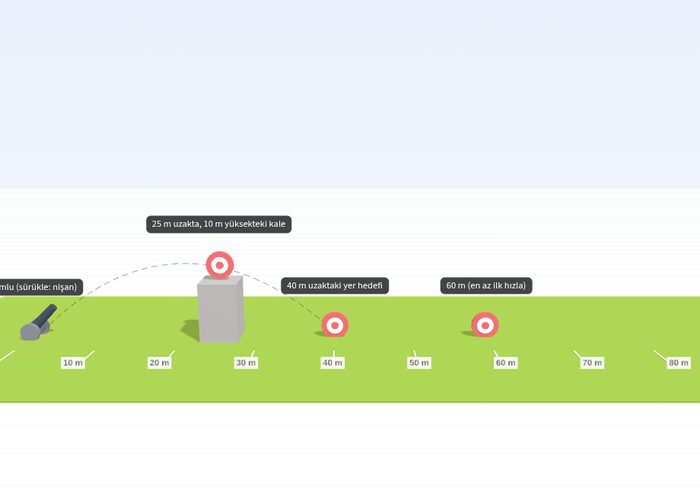
You can test your sharpshooting skills by completing target-hitting missions.
You can reinforce your theoretical knowledge by answering questions accompanied by the guide.
Basic concepts and formulas
Constant acceleration motion in two dimensions is the combination of two independent motions horizontally and vertically. The horizontal acceleration is zero (constant velocity), while vertical acceleration (g) is effective. The basic formulas are: Horizontal velocity component Vx = v0·cos(α), vertical velocity component Vy = v0·sin(α) - g·t, maximum height H = (v0·sin(α))^2 / (2·g), and horizontal range R = (v0^2·sin(2α)) / g.
How to use?
Open the experiment screen and determine the launch angle, initial velocity, and height parameters.
Make your prediction, save it, and then start the experiment.
Perform the projectile launch and observe the trajectory, flight time, and range on the screen.
Aim in the target-hitting missions and try to hit the 3 target.
Check your results and close your knowledge gaps by answering the questions in the guide.
Frequently asked questions
At what angle is the maximum range achieved in projectile motion?
When air resistance is neglected, a launch angle of 45 degrees provides the maximum horizontal range an object can achieve.
Do horizontal and vertical motions affect each other?
According to Galileo's principle, horizontal and vertical motions are independent of each other; the horizontal velocity does not alter the vertical free-fall motion.
What does the flight time depend on?
The flight time varies depending on the vertical component of the object's initial velocity and the launch height.
 Interactive experiment