Newton's laws of motion: pull the cart on the table with a suspended mass; calculate and measure acceleration and string tension with F = m·a; weight variation shown by a scale in an elevator due to acceleration (action–reaction)
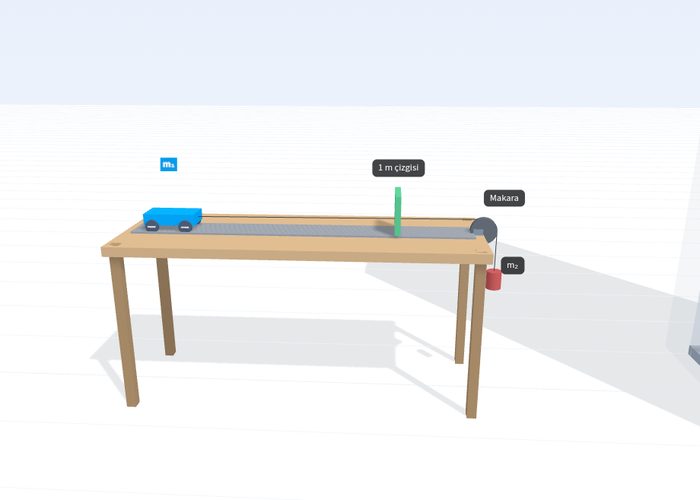
Interactively explore the principles of force, acceleration, and action-reaction with Newton's Laws of Motion simulation. By pulling the cart on the table with the help of a suspended mass, you can calculate and measure the acceleration and string tension using the relation F = m·a, and observe how the apparent weight changes in an elevator. It is a great digital experiment tool to reinforce dynamics topics in high school physics.
What can you do in this simulation?
You can move the cart on the table with combinations of suspended masses and measure the acceleration values.
You can calculate different string tension scenarios and compare them with the simulation results.
You can examine the action-reaction forces and the apparent weight shown by the scale in the elevator scenario.
You can test your theoretical knowledge with practice by answering questions step by step with the guide.
You can grasp the laws of dynamics by trying 3 different combination and acceleration scenarios.
Basic concepts and formulas
According to Newton's second law, the net force acting on a system is equal to the product of mass and acceleration (F_net = m·a). In suspended mass systems, the acceleration of the system is found by the formula a = (m_suspended / (m_cart + m_suspended)) · g. In elevator movements, the apparent weight changes according to the resultant of the gravitational acceleration and the acceleration of the elevator (N = m(g ± a)).
How to use?
Open the experiment screen and go to the "Newton's Laws Table" section.
Select different combinations for the suspended mass and cart mass.
Record your prediction, start the experiment, and observe the acceleration and string tension.
Switch to the elevator and scale mode to examine the action-reaction changes.
Answer the questions in the guide to complete your shortcomings and check the results.
Frequently asked questions
Is string tension always equal to mass weight?
No, because the system moves with acceleration, the string tension is different from the weight of the suspended mass and is calculated using the relation F_net = m·a.
What does the scale show while the elevator is accelerating upward?
When the elevator accelerates upward, due to the action-reaction principle, the scale shows a value greater than the actual weight (apparent weight).
What topics does this simulation cover?
The simulation covers Newton's Laws of Motion and dynamics subtopics of the Force and Motion unit in the 11th grade physics curriculum.
 Interactive experiment