Friction force: pull the box with increasing force and see the drop from static to kinetic friction on the graph; find the friction coefficient with μs = tan θ from the critical angle where sliding begins by increasing the incline angle; compare surface pairs
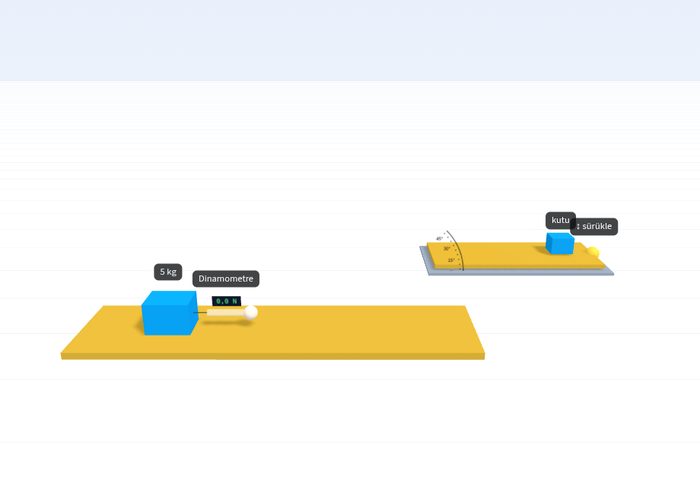
Explore the resistance forces we encounter in daily life interactively with the friction force simulation. By pulling the box with increasing force, you can instantly examine the drop from static to kinetic friction on the graph, and calculate the coefficient of friction from the critical angle where sliding begins by increasing the inclined plane angle.
What can you do in this simulation?
You can compare different surface pairs such as wood-wood, ice-steel, rubber-asphalt, and teflon-teflon.
You can observe the static friction limit and the moment of transition to kinetic friction by pulling the box with increasing force.
You can find the critical angle at which the object begins to slide by adjusting the inclined plane angle.
You can reinforce your theoretical knowledge with true-false feedbacks and restart the steps.
Basic concepts and formulas
Friction force is a force caused by surface roughness between surfaces and is directed opposite to motion. The maximum value before motion starts is the static friction force (Fs = μs · N). When the object starts to move, the kinetic friction force (Fk = mk · N) comes into play and is usually smaller than static friction. On an inclined plane, the tangent of the critical angle directly gives the coefficient of static friction: μs = tan(θ).
How to use?
Select the surface pair you want to examine from the experiment panel.
Observe the changes in static and kinetic friction by applying a pulling force to the box.
Switch to the inclined plane mode, slowly increase the angle, and catch the critical point where the object moves.
Check the results by answering the questions and recording your predictions.
Frequently asked questions
Why is the static friction force greater than the kinetic friction?
When objects are at rest, molecular contact points on the surface interlock better, which makes it harder to initiate motion. After motion begins, the friction force drops because these bonds cannot be fully established.
How is the coefficient of friction found on an inclined plane?
The tangent of the tilt angle (critical angle) at the exact moment the object starts to slide is equal to the static friction coefficient of that surface: μs = tan(θ).
Which surface pairs can be tested in this experiment?
In the simulation, you can compare and examine surface pairs with different friction coefficients such as wood-wood, ice-steel, rubber-asphalt, and teflon-teflon.
 Interactive experiment