Ecological footprint calculator: select nutrition, transportation, energy and consumption habits; see the global hectares and 'how many Earths are needed' result; try choices that shrink your footprint
Discover the impact of your daily habits on nature with the ecological footprint calculator simulation. In this interactive experiment, by changing your diet, transportation, energy, and consumption choices, you can see your pressure on our planet and learn what you can do for a sustainable life. It is an excellent guide for high school biology classes and ecology studies.
What can you do in this simulation?
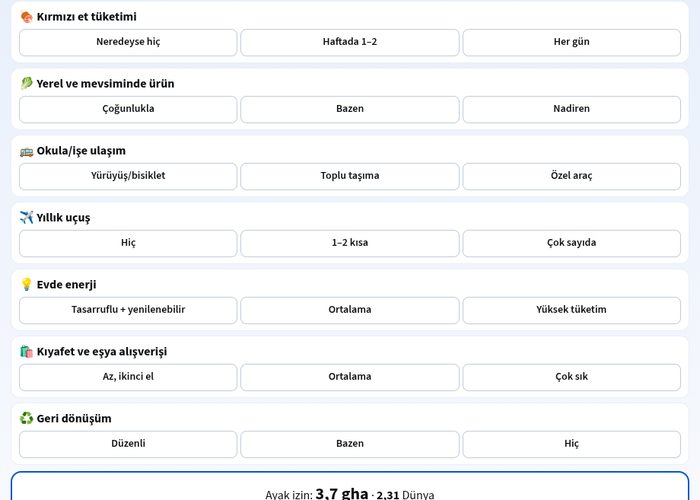
You can observe the impact of diet on the carbon footprint by choosing local and seasonal product consumption habits.
You can try walking, cycling, public transportation, or private vehicle options for commuting to school or work.
You can calculate the equivalent of your travel habits in global hectares (gha) by adjusting your annual flight frequency.
You can examine the consequences of energy consumption by choosing home energy use and energy-saving methods.
You can update your clothing, goods shopping, and recycling habits to test how many Earths would be required.
Basic concepts and formulas
The ecological footprint is a metric that measures human activity's demand on nature and is expressed in global hectares (gha). Earth's average per capita footprint is approximately 3,3 gha. The calculation basically works with this logic: T = T_transport + T_diet + T_energy + T_consumption. For a sustainable life, it is aimed that this total does not exceed the limit of 1 Earth on an individual level.
How to use?
Determine the options suitable for you from the diet, transportation, and energy categories on the simulation screen.
Place your habits into the relevant boxes by tapping on the cards or dragging and dropping them.
Complete the calculation by updating your recycling and shopping preferences.
Examine how many Earths will be needed on the result screen and try new choices to shrink your footprint.
Frequently asked questions
What is an ecological footprint?
It is the measure, in global hectares, of the biologically productive land and water area required to produce the resources consumed by humans and to absorb the wastes they generate.
What does the "how many Earths are needed" result mean?
It provides a ratio showing how many planet Earths would be required to meet humanity's demands if everyone in the world lived like you.
What should be the first step to shrink your footprint?
Choosing public transport or walking for travel, eating locally and seasonally, and saving energy at home quickly shrink your footprint.
 Interactive experiment