Matter cycles: place the processes in water, carbon and nitrogen cycles into the correct cycle and stage; simulate the effect of fossil fuel use on atmospheric CO₂ in the carbon cycle
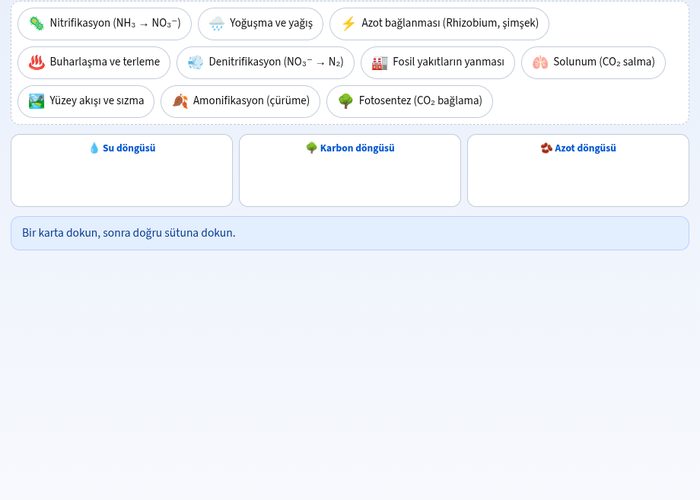
Explore interactively the critical processes in the water, carbon, and nitrogen cycles, which are fundamental topics of ecology, with the biogeochemical cycles simulation. In this experiment aligned with the 10 grade biology curriculum, you will comprehend the flow of elements in nature between living organisms and the environment, learning by placing processes into the correct cycle and stage. You will have the opportunity to observe how the use of fossil fuels changes the amount of carbon dioxide (CO₂) in the atmosphere within the carbon cycle.
What can you do in this simulation?
You can examine the processes belonging to the water, carbon, and nitrogen cycles.
You can place critical stages such as evaporation, transpiration, photosynthesis (CO₂ fixation), and nitrogen fixation into the correct boxes.
You can test the role of Rhizobium bacteria in the nitrogen cycle and the events taking place in the roots.
You can match processes by dragging and dropping or touching cards, and receive instant feedback.
You can simulate the effect of fossil fuel use on the atmospheric CO₂ level.
Basic concepts and formulas
Biogeochemical cycles are the circulation of elements (water, carbon, nitrogen) between the living and non-living environment to sustain life in the ecosystem. In the carbon cycle, photosynthesis decreases the atmospheric CO₂ ratio, while the burning of fossil fuels and respiration increase this ratio. In the nitrogen cycle, free nitrogen (N₂) in the atmosphere is converted into forms that living things can use via Rhizobium bacteria or lightning.
How to use?
Read the guide on the screen to follow the instructions and examine the cycle objectives.
Place the processes into the relevant cycle boxes by touching the cards or dragging and dropping them.
After filling in all the blanks, press the "Check" button to review your answers.
Review incorrect matches and repeat the experiment by making use of the hints.
Frequently asked questions
What main processes take place in the water cycle?
The water cycle takes place between the Earth's surface and the atmosphere primarily through physical processes such as evaporation, transpiration, condensation, and precipitation.
What do Rhizobium bacteria do in the nitrogen cycle?
These bacteria provide nitrogen fixation by converting free nitrogen gas (N₂) in the atmosphere into compounds such as ammonia that plants can use.
How do fossil fuels affect the carbon cycle?
The overuse of fossil fuels causes carbon trapped underground for a long time to be rapidly released into the atmosphere as CO₂ gas, leading to the greenhouse effect.
 Interactive experiment