Population and community: logistic growth approaching carrying capacity, rabbit–fox predator-prey cycles; classify mutualism, commensalism, parasitism, competition and predator-prey relationships
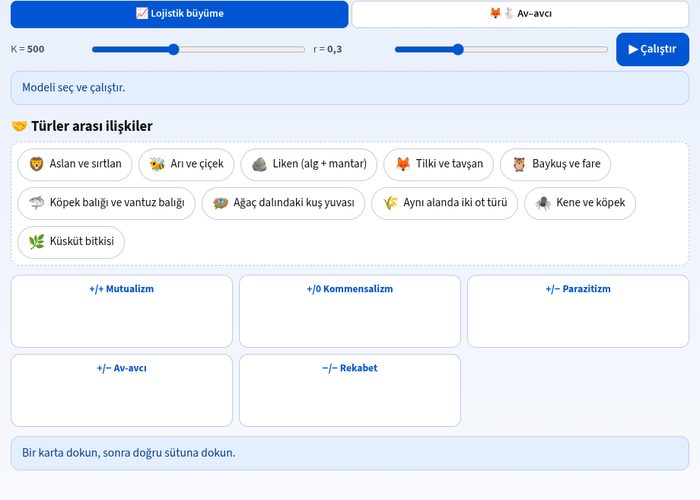
Explore the fundamental dynamics of ecology with the Populations and Community Relationships simulation. In this interactive experiment, you will learn mutualism, commensalism, parasitism, and predator-prey relationships by classifying organism interactions such as bee-flower, shark-remora, tick-dog, and fox-rabbit.
What can you do in this simulation?
- You can drag and drop cards showing organism relationships into the correct categories.
- You can examine logistic growth models approaching the carrying capacity.
- You can observe predator-prey cycles between foxes and rabbits.
- You can discover population density by performing calculations of individual count and area.
- You can test the effects of birth, death, and migration factors on a population.
Basic concepts and formulas
Population dynamics in ecology are explained by specific mathematical models. Population density is found by dividing the number of individuals by the area. In the logistic growth model, when the population reaches the carrying capacity (K), the growth rate slows down and reaches equilibrium. Symbiotic relationships (mutualism, commensalism, parasitism) and competition among organisms determine the structure of communities.
How to use?
- Open the experiment panel and examine the questions with the guide.
- Place the ecological relationships by matching the cards and categories.
- Observe the simulation by running the logistic growth and predator-prey graphs.
- Check your predictions and evaluate the results.
Frequently asked questions
What is logistic growth?
Logistic growth refers to the population increasing slowly at first, then rapidly, and leveling off as it approaches the carrying capacity when resources are limited.
How does the predator-prey relationship affect population?
As seen in the fox and rabbit example, changes in the prey population directly affect the predator population, creating a cyclical fluctuation.
Which ecological relationships are examined in the simulation?
The simulation covers population and community interactions such as mutualism, commensalism, parasitism, competition, and predator-prey relationships.
 Interactive experiment