Tip-to-tail, parallelogram, and component methods: step-by-step animated vector addition
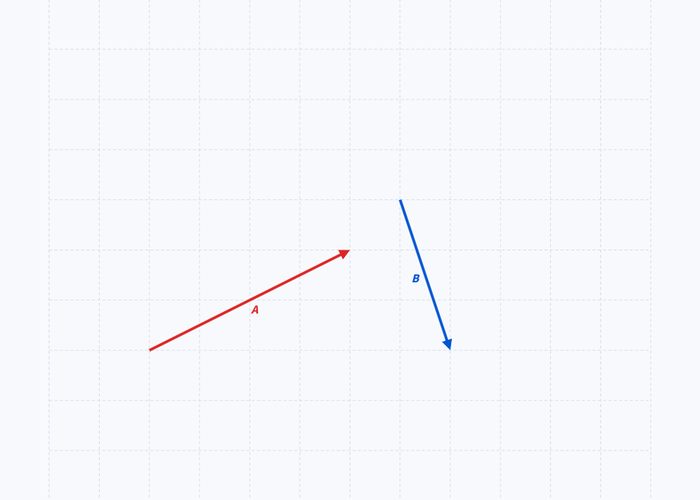
Discover step by step how to combine physical quantities such as force, velocity, and displacement with the vector addition simulation. This interactive experiment allows you to learn tip-to-tail, parallelogram, and component methods through practice.
What can you do in this simulation?
- You can find the resultant vector by lining up vectors consecutively using the tip-to-tail method.
- You can examine the effect produced by two vectors from a common starting point with the help of the parallelogram method.
- You can add up the projections of vectors on the x and y axes separately by using the component method.
- You can test different physical situations such as force + force, velocity + velocity, or airplane scenarios under wind effect.
- You can answer questions with a step-by-step guide and test your predictions with the experiment.
Basic concepts and formulas
Vectors are quantities that have both magnitude and direction. The resultant vector R, which is the sum of two vectors, is the same regardless of the method used to find it. In addition using components, the formulas Rx = Σax and Ry = Σay are used. The magnitude of the resultant vector is calculated with the relation R = √(Rx² + Ry²).
How to use?
- Go to the experiment panel, read the instructions, and examine the scenario presented to you.
- Place the cards or vectors into the relevant boxes or columns by dragging and dropping or tapping.
- Follow the steps by choosing one of the tip-to-tail, parallelogram, or component methods.
- Test your answer by pressing the check button and observe the correct results.
Frequently asked questions
Do different methods yield different resultant vectors?
No, regardless of whether you use the tip-to-tail, parallelogram, or component method, the resultant vector remains the same when applied correctly.
How is the component method applied?
Each vector is resolved into its rectangular components (x and y axes). Values along the same axis are added algebraically to find R_x and R_y, and then these values are combined.
Which physical quantities are covered in this simulation?
The experiment mainly includes force and velocity vectors, practical problems involving unit conversions, and real-life scenarios such as an airplane in a crosswind.
 Interactive experiment