Gravitational, electromagnetic, strong, and weak nuclear forces: compare with four small simulations
Interactively discover the four fundamental interactions in the universe and reinforce your physics knowledge with the Fundamental Forces in Nature simulation. In this activity, you will directly compare the concepts of gravity, electromagnetic force, strong nuclear force, and weak nuclear force through four separate mini-experiments. You can safely use this digital tool to better understand the force and motion unit in physics class.
What can you do in this simulation?
- You can switch between gravitational, electromagnetic, strong, and weak nuclear force experiments via the tab panel at the top.
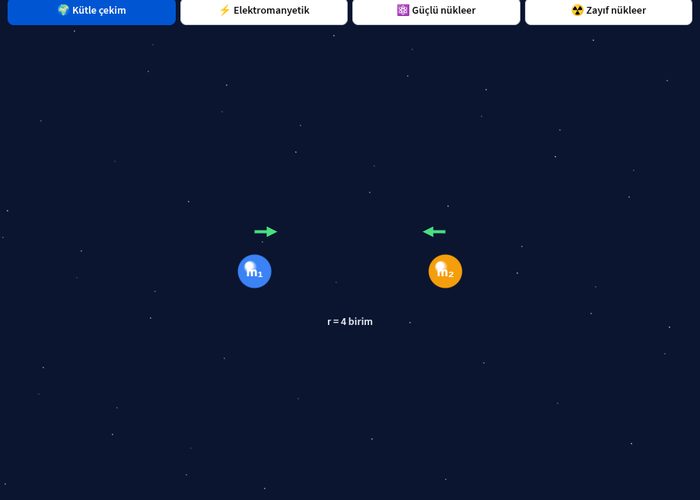
- In the Gravity tab, you can change the distance between objects and observe how the force decreases with distance.
- In the Electromagnetic tab, you can test both repulsion and attraction states, and examine effects such as magnets and lightning.
- In the Strong Nuclear tab, you can toggle the strong force on and off to see how the stability of the atomic nucleus is disrupted.
- In the Weak Nuclear tab, you can initiate carbon-14 decay to watch a neutron turn into a proton and carbon atoms turn into nitrogen.
Basic concepts and formulas
All physical phenomena in the universe are built upon four fundamental forces. Gravity and electromagnetic forces have infinite range; gravity always exerts an attractive force between masses, while the electromagnetic force exerts both repulsion and attraction between charges using laws similar to F = k·(q1·q2)/r2. The strong nuclear force and weak nuclear force, on the other hand, are effective only at the subatomic level, meaning a short range. While the strong nuclear force holds protons and neutrons together in the nucleus, the weak nuclear force is responsible for radioactive decays.
How to use?
- Open the simulation screen and select the fundamental force you want to examine from the tab panel at the top.
- Follow the guide instructions to drag and drop the cards into the appropriate boxes or click the relevant buttons.
- Observe the system's response by changing the parameters (distance, strong force on/off status, initiating decay).
- Answer the questions, check their accuracy, and repeat the experiment by pressing the restart button if necessary.
Frequently asked questions
How many fundamental forces are there in nature, and which ones have an infinite range?
Fundamental forces in nature are divided into four: gravitational, electromagnetic, strong nuclear, and weak nuclear forces. Among these, gravitational and electromagnetic forces have an infinite range, whereas strong and weak nuclear forces are effective only at the subatomic scale.
Why is the strong nuclear force so important for the atomic nucleus?
Positively charged protons with the same charge repel each other due to the electromagnetic repulsive force. The strong nuclear force applies enough attraction to overcome this repulsion, ensuring that the atomic nucleus stays together without breaking apart.
Which fundamental force is Carbon-14 decay associated with?
The process of Carbon-14 turning into nitrogen is associated with the weak nuclear force. This force drives structural changes in the atomic nucleus and radioactive beta decays.
 Interactive experiment