Two people pushing a couch: how to get 70 N, 10 N, and 50 N using the same forces of 30 N and 40 N? The importance of direction
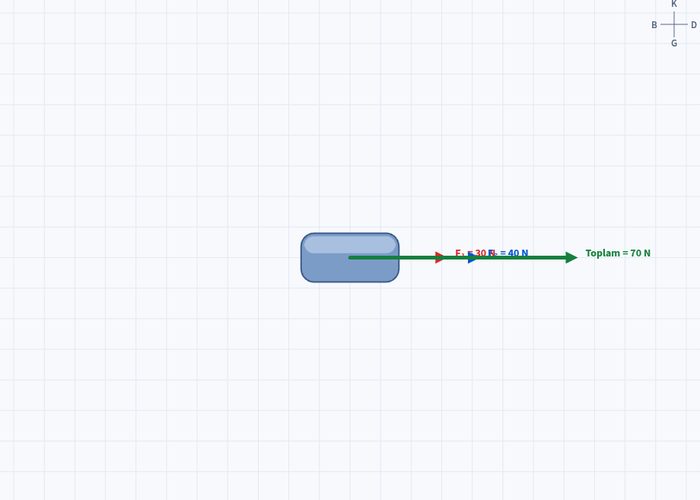
You can interactively explore how the direction of forces affects the net force with the Scalar and Vector Quantities simulation. You will reinforce the concept of vectors in physics by seeing that forces of the same magnitude can yield different results such as 70 N, 10 N, or 50 N by changing direction. This experiment allows you to understand the mathematical background of force applications we encounter in daily life.
What can you do in this simulation?
- You can change the direction of forces using sliders or by dragging the tips of the arrows.
- You can obtain 70 N, 10 N, and 50 N net force by using the same 30 N and 40 N forces.
- You can examine the perpendicular net force by setting the angle between the forces to 90 degrees.
- You can test the differences between scalar and vector quantities with questions.
- You can test your predictions on the experiment screen by proceeding step by step accompanied by the guide.
Basic concepts and formulas
In physics, quantities expressed with only a number and a unit are called scalar quantities (e.g., mass, temperature), while quantities that also have a direction and sense are called vector quantities (e.g., force, velocity). Vectors along the same line are added if they are in the same direction (R = F1 + F2), and subtracted if they are in opposite directions (R = F1 - F2). For perpendicularly intersecting vectors, the net force is calculated with the Pythagorean relation using the formula R = √(F1² + F2²).
How to use?
- Open the experiment screen and read the guide's instructions.
- In the scenario where two people are pushing a sofa, adjust the direction of the forces using sliders or arrows.
- Using the same forces, first make their sum 70 N, then make them opposite directions to obtain 10 N.
- Set the angle between the forces to 90° and observe the sum of the perpendicular forces (50 N).
- Test your predictions by pressing the check button and evaluate the results.
Frequently asked questions
How to get 10 N using 30 N and 40 N forces?
When forces are applied in exact opposite directions (when the angle between them is 180 degrees), they subtract from each other and the net force becomes 40 - 30 = 10 N.
Why is the sum of perpendicular forces 50 N?
When forces are perpendicular to each other (90°), the Pythagorean theorem is applied. The sum of the square of 30 (900) and the square of 40 (1600) makes 2500, and its square root is found to be 50 N.
What is the main difference between scalar and vector quantities?
Scalar quantities only have magnitude and a unit, whereas vector quantities also have direction and sense in addition to these.
 Interactive experiment