3D measurement lab: measure fundamental quantities with a ruler, scale, and stopwatch; derive volume, density, and speed
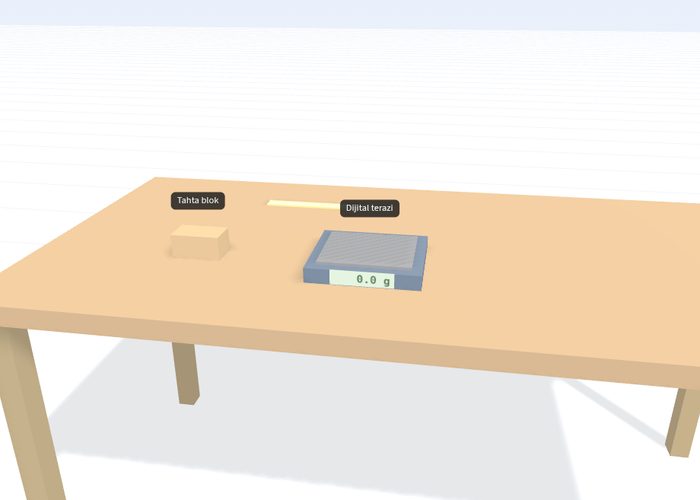
Explore the world of measurement in physics interactively with the fundamental and derived quantities simulation. You will learn to measure the dimensions and mass of a wooden block and the movement duration of a toy car by using measuring tools such as a ruler, scale, stopwatch, and thermometer. Thanks to this interactive experiment, you will reinforce the concepts of mass, length, time, and temperature as fundamental quantities, as well as volume, density, and speed derived from these quantities.
What can you do in this simulation?
- You can measure the length, width, and height values of the wooden block with a ruler and tape measure.
- You can determine the mass of the wooden block in kilograms with the help of a digital scale.
- You can examine the measurement of how long it takes a toy car to cover a certain distance by using a stopwatch.
- You can calculate the volume by multiplying the measured sides with each other and reach the density by dividing the mass by the volume.
- You can calculate the speed of the car by dividing the distance by the time and answer the fundamental-derived quantity classification questions.
Basic concepts and formulas
In physics, quantities are divided into two: fundamental quantities, which can be measured directly, and derived quantities, obtained through mathematical operations on multiple fundamental quantities. In the SI unit system, mass (m), length (L), time (t), and temperature (T) are examples of fundamental quantities. Density (d) and speed (v) are derived quantities:
- Volume = Length · Width · Height
- Density = Mass / Volume (d = m / V)
- Speed = Distance / Time (v = x / t)
How to use?
- Select the measuring tool—ruler, balance, or stopwatch—from the experiment panel.
- Measure and record the three sides of the wooden block with the ruler.
- Read the mass by placing the block on the digital balance.
- In the toy car experiment, complete the calculations by matching the time and distance with the stopwatch.
- Follow the guide steps to drag the measurement results into the relevant boxes and answer the questions.
Frequently asked questions
What is the difference between fundamental and derived quantities?
Fundamental quantities are quantities that can be measured directly without the need for another measurement (mass, length, etc.). Derived quantities are obtained by multiplying or dividing fundamental quantities (density, velocity, etc.).
From which fundamental quantities is volume derived?
Volume is a quantity derived by multiplying the fundamental quantity of length three times (width, height, depth) with each other.
What are the units of time and temperature in the SI unit system?
In the SI unit system, the unit of time is accepted as the second (s), and the unit of temperature is accepted as the kelvin (K).
 Interactive experiment