Translation, rotation, and vibration: observe six motions on the 3D stage, classify them with a motion-tracing point
With the types of motion simulation, you can examine translational, rotational, and vibrational motions in a 3D scene and reinforce the fundamentals of physics by classifying real-life examples. In this interactive activity, you will learn to distinguish types of motion by observing the trail-leaving points of objects.
What can you do in this simulation?
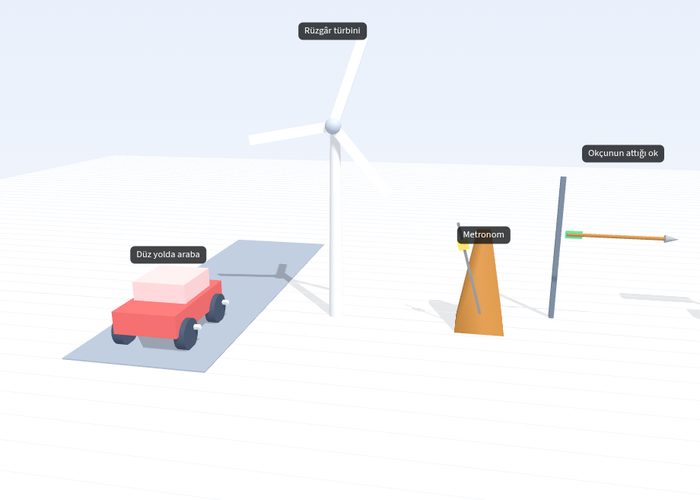
- You can observe more than four different motions (a car on a straight road, a wind turbine, a person swinging on a swing, etc.) in a 3D scene.
- You can examine the trajectories of objects by following the trail-leaving points.
- You can classify the given motion cards by dragging and dropping them into the correct categories such as translation, rotation, and vibration.
- You can instantly test your guesses using the check button and receive correct or incorrect feedback.
- You can follow the steps with the help of the guide and correct any missing or incorrect placements.
Basic concepts and formulas
In physics, motion is defined as the change in position of an object over time relative to a reference point. Translational motion is the displacement of all points of an object in the same direction, rotational motion is following a circular path around an axis, and vibrational motion is back-and-forth oscillation between two points. Complex movements in daily life frequently consist of a combination of these three basic types (for example, a wheel performing both translation and rotation).
How to use?
- Read the guide on the experiment screen to examine the motions presented in the 3D scene.
- Tap on the cards or objects and consider which motion they represent.
- Drag and place the cards into the appropriate boxes (translation, rotation, vibration).
- Test the accuracy of your matches by pressing the check button.
- Reorganize missing or incorrect matches by making use of the hints.
Frequently asked questions
What is the main difference between translational and rotational motion?
In translational motion, all points of the body move in the same direction and along parallel trajectories, whereas in rotational motion, the body traces a circle around a fixed axis or point.
Can an object undergo both translational and rotational motion at the same time?
Yes, for example, a bicycle wheel or the wheel of a moving car both moves forward in translational motion and rotates around its own axis.
How is vibrational motion defined?
The periodic back-and-forth motion between two boundary points is called vibration; a person swinging on a swing or spring systems are examples of this.
 Interactive experiment