Equal, opposite, and real-number-multiplied vectors: draw and examine vectors on a grid plane
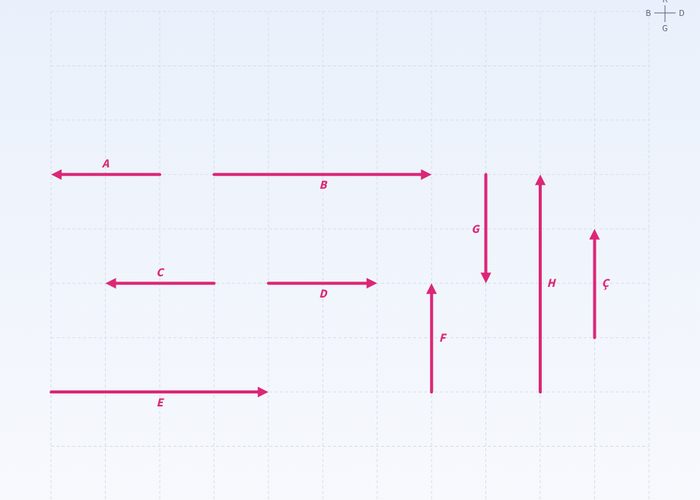
Interactively explore the concepts of direction, magnitude, and equal vectors on a grid plane with the Properties of Vectors simulation. This activity allows you to understand the properties of directed lines and visualize multiplication operations with real numbers.
What can you do in this simulation?
- You can easily draw a vector by dragging it from a point on the grid plane.
- You can obtain exact values thanks to the vectors you draw snapping to the grid corners.
- You can instantly learn the directions and magnitudes of vectors by tapping on them.
- You can examine the results by performing vector multiplication with positive or negative real numbers (for example, -2D or 3/2 F).
- You can observe vector changes in the east, west, north, and south directions.
Basic concepts and formulas
Vectors are quantities that have both direction and magnitude. The magnitude of a vector A is calculated using the formula R = |A| = √(dx² + dy²). For two vectors to be equal, both their directions and magnitudes must be the same. When a vector is multiplied by a real number k, its direction (reverses if k is negative) and magnitude (changes by a factor of |k|) can change.
How to use?
- Open the experiment screen and set the starting point on the grid plane.
- Draw a vector in the direction you want by dragging with your mouse or finger.
- Check the direction and magnitude in units of the vector by tapping on it.
- Answer questions about equal, opposite, and scalar-multiplied vectors by following the steps in the guide.
Frequently asked questions
What does it mean for vectors to be equal?
For two vectors to be equal, both their magnitudes (unit lengths) and their directions must be completely identical.
What happens if a vector is multiplied by a negative number?
While the magnitude of the vector changes by being multiplied by the absolute value of the number, its direction reverses completely.
How is the magnitude of a vector calculated?
It is calculated by taking the square root of the sum of the squares of the horizontal (dx) and vertical (dy) components on a grid plane (Pythagorean theorem).
 Interactive experiment