Hydraulic lift (Pascal's law), communicating vessels, and apartment water tank: three-station 3D lab
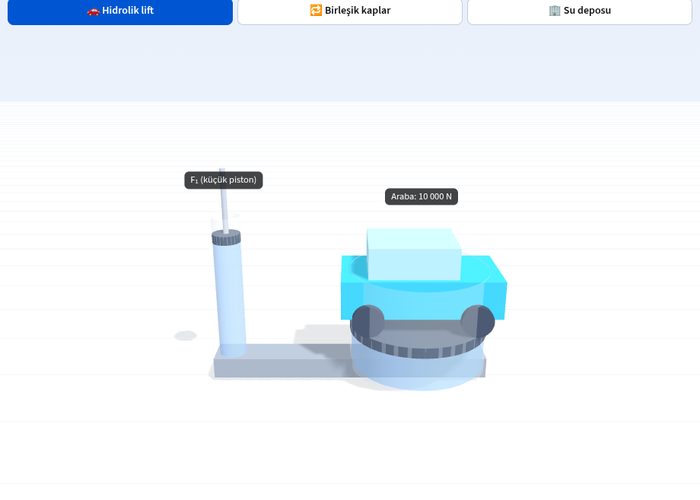
The Systems Using Fluid Pressure simulation allows you to explore hydraulic systems such as Pascal's law, communicating vessels, and apartment water tanks in a three-station 3B laboratory. With this interactive experiment, you will observe how fluids transmit pressure in all directions and grasp the logic of hydraulic lifts and presses. You will learn the fundamental principles in the fluids unit while having fun and practicing.
What can you do in this simulation?
- You can test the force relationship between small and large pistons at the hydraulic lift station.
- You can observe how water levels equalize by opening the tap in communicating vessels.
- You can examine the flow of water from taps on different floors at the water tank station.
- You can reinforce your knowledge with question and card-matching activities, and test your predictions through experiments.
Basic concepts and formulas
Due to being incompressible, fluids transmit the pressure applied to them in every direction equally; this principle is called Pascal's Principle. In hydraulic systems, a small force applied to the small piston allows a much larger force to be obtained on the large piston. The formula used is F1 / S1 = F2 / S2, where F denotes the force and S denotes the piston surface area. Fluid pressure, on the other hand, is calculated with the formula P = h · d · g (where h is depth, d is density, and g is gravitational acceleration).
How to use?
- Select the station you want to examine from the activity screen.
- Follow the instructions on the experiment panel to open the taps or apply force to the pistons.
- Check your answers by dragging and dropping prediction cards into the corresponding boxes.
- See your score by answering the questions and review the steps where you need improvement.
Frequently asked questions
Where do we encounter Pascal's law in daily life?
Hydraulic brakes, hydraulic lifts, fire truck ladders, and dump trucks operate on this principle.
Do the shapes of the arms in communicating vessels affect the fluid level?
No, regardless of the width or shape of the arms, when the fluid is in equilibrium, the fluid levels in all arms equalize.
Why do dam walls become thicker toward the bottom?
Because as depth increases, fluid pressure also increases; the walls are made thicker toward the base to withstand this high pressure.
 Interactive experiment