Drop bricks onto sand with different surfaces and weights; discover the pressure model P = F/A from sinking depth (3D)
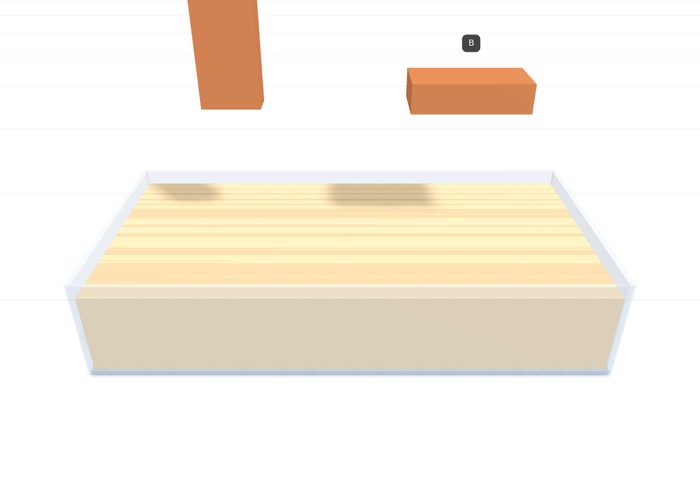
Interactively explore the relationship between solid pressure, surface area, and weight with the Pressure: Sand and Brick Experiment simulation. In this activity, you measure sinking depths by placing bricks onto the sand with their different surfaces and weights, testing your theoretical knowledge with practical observations. It is an ideal application to reinforce fundamental pressure principles in physics class.
What can you do in this simulation?
- You can observe the effect of surface area by placing the bricks onto the sand in wide-face, side-face, or upright (small-face) positions.
- You can examine the changes in weight and surface area in different setups such as Figure I, II, III, IV, and V.
- You can formulate your hypothesis, make measurements on the experiment panel, and instantly compare the results.
- You can interpret pressure changes by examining the data on pit depths measured with a ruler.
- You can answer questions by proceeding step-by-step with the guide and track your score.
Basic concepts and formulas
Solid pressure is obtained by dividing the force applied perpendicular to the surface by the surface area this force contacts. The basic formula is P = F / A. Here, P represents pressure, the force per unit area (in Pascals), F represents the perpendicular force or weight applied to the surface (in Newtons), and A represents the contacting surface area (in square meters). In this simulation, it is clearly seen that as the force (weight) increases, the pressure increases, and as the contact surface increases, the pressure decreases.
How to use?
- Read the scenario presented to you, determine your hypothesis, and record it.
- Drop the bricks onto the sand in the desired positions (horizontal, vertical, or stacked).
- Measure the pit depths with the help of a ruler and record the results.
- Observe the effect of changing parameters (weight or surface area) on the sinking depth.
- Complete the evaluation stage by answering the questions.
Frequently asked questions
Why does pressure increase when the surface area decreases?
When the same weight acts on a smaller area, the amount of force falling per unit area increases, which causes the pressure to rise.
How does the sinking depth change when the number of bricks doubles?
If the weight doubles while the surface area remains constant, the applied force will also double, causing the pressure and sinking depth to double in direct proportion.
In which areas of daily life do we encounter this experiment?
The wide bases of snowshoes, the tracked structure of construction machinery, or the thin, sharp edge of a knife are directly related to these principles of solid pressure.
 Interactive experiment