Pressure forces acting on the surfaces of a cube in fluid, F_b = F_bottom − F_top; floating, sinking, suspension, and submarine
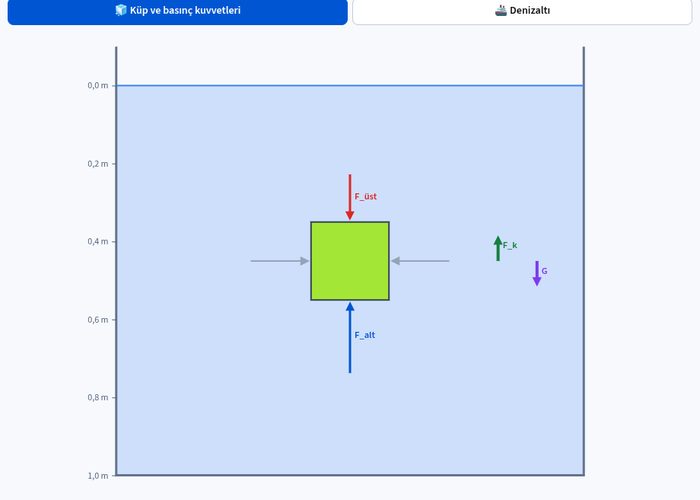
The Buoyant Force and Pressure Force simulation is an interactive tool that allows you to discover how the pressure forces acting on the bottom and top surfaces of objects in a liquid create the buoyant force. Thanks to this experiment, you can examine the conditions for floating, sinking, and suspension, and visualize the relationship between the pressure force difference and the buoyant force. A great opportunity to reinforce the concepts in the fluids unit.
What can you do in this simulation?
- You can observe the forces acting on the bottom and top surfaces by taking the cube to different depths.
- You can create three different equilibrium states by making the cube float, sink, or remain suspended.
- You can test the ballast tank logic by diving and surfacing in submarine mode.
- You can reinforce your theoretical knowledge through card matching and question steps.
Basic concepts and formulas
The buoyant force acting on an object inside a liquid is equal to the difference between the pressure force acting on the bottom surface and the pressure force acting on the top surface: F_b = F_bottom − F_top. As depth increases, liquid pressure (P = h·d·g) increases; this makes the pressure force on the bottom surface greater than the one on the top, creating a net upward buoyant force.
How to use?
- Explore the simulation area by following the guide on the experiment screen.
- Place the cube or submarine at different depths by dragging it.
- Observe the change in pressure forces by examining the lengths of the arrows.
- Proceed by answering the questions and testing your predictions with the experiment.
Frequently asked questions
Where does the buoyant force come from?
The buoyant force is a net force arising from the difference in liquid pressure between the bottom and top surfaces of the object. Since the bottom surface is deeper, the upward pressure force there is greater than the downward force at the top.
Why does an object sink or float?
If the weight of the object is greater than the buoyant force exerted by the liquid, the object sinks. When the buoyant force is equal to or greater than the weight, the object floats or is suspended.
How do submarines dive and surface?
Submarines take water into their ballast tanks to increase their average density and sink; when they pump the water out, their average density decreases and they surface.
 Interactive experiment