Measure the effect of depth, fluid density, gravity, and container shape with a pressure probe: P = h·d·g (3D)
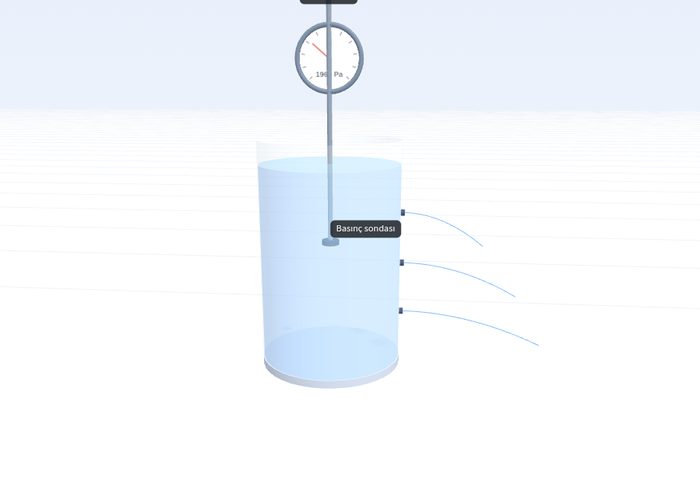
Interactively explore how fluid pressure changes depending on depth, density, and gravitational acceleration with the pressure in stationary fluids simulation. This experiment allows you to learn by materializing the principles of hydrostatic pressure, which form the basis of fluid mechanics. Designed for high school students studying the fluids unit, this tool allows you to test different fluids such as olive oil and observe the effect of container shape on pressure.
What can you do in this simulation?
- You can make measurements at different depths by using the pressure probe and see how pressure increases as the depth increases.
- You can examine the direct effect of density on pressure by selecting different fluid densities.
- You can discover the role of the g value by experimenting in different gravitational acceleration environments such as Earth, the Moon, or Mars.
- You can compare the base pressure in narrowing, widening, or differently shaped containers.
- You can test your theoretical knowledge with practical measurements by answering the guided questions.
Basic concepts and formulas
The pressure applied to the base or any point in stationary fluids originates from the weight of the fluid. It is calculated by multiplying the depth (h), fluid density (d), and gravitational acceleration (g). The pressure acting on the bottom of the container does not depend on the shape of the container or the base area; it depends solely on the fluid height and type.
Formula: P = h·d·g
How to use?
- Select a fluid from the experiment panel and submerge the depth probe.
- Record the pressure values by moving the probe to different depths.
- Observe the change in the read values by altering the density and gravity parameters.
- Compare the base pressures in different containers using the container shape modification step.
- Reinforce what you have learned by solving the questions in the guide.
Frequently asked questions
Does the shape of the container affect fluid pressure?
No, fluid pressure does not depend on the shape or width of the container. Pressure depends solely on depth, the density of the fluid, and gravitational acceleration.
Why does pressure increase as depth increases?
As depth increases, the weight of the fluid column remaining above the measurement point and consequently the amount it carries increase, which is directly reflected in the pressure.
How does density change pressure?
Denser fluids (for example, heavier fluids instead of water) create higher pressure at the same depth because they contain more mass per unit volume.
 Interactive experiment