Torricelli's experiment: measure atmospheric pressure with altitude, tube inclination, and fluid type; rising balloon (3D)
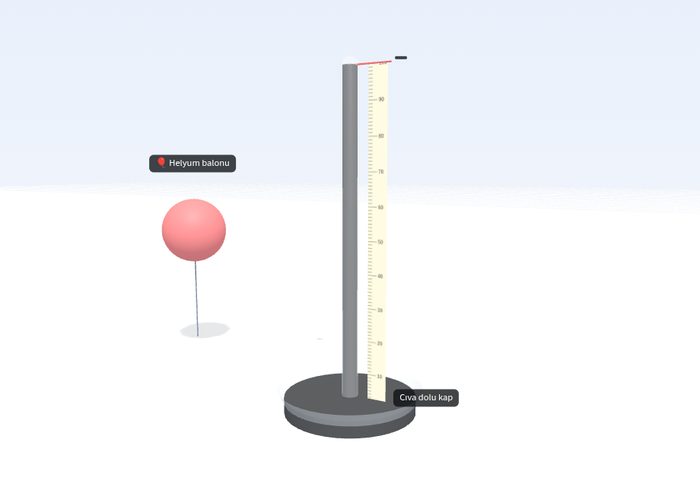
Interactively explore the effects of atmospheric pressure on Torricelli's experiment, altitude changes, tube inclination, and liquid type with the atmospheric pressure simulation. This activity is a great opportunity for you to reinforce the 9th grade physics fluids unit and grasp the logic behind atmospheric pressure. You can observe how the height of the mercury column changes at different heights from sea level to Everest, and examine the behavior of a rising helium balloon.
What can you do in this simulation?
- You can observe the change in atmospheric pressure by selecting different altitude options such as Izmir sea level, Ankara, Palandöken, Mount Ararat, and Everest.
- You can test the effect of liquid type on column height by using water instead of mercury in Torricelli's experiment.
- By changing the tube inclination parameter, you can realize that the vertical height of mercury is independent of the inclination.
- You can examine how the volume of the balloon and the pressure change as it rises by running the 33D helium balloon animation.
- You can instantly test your theoretical knowledge with true-false tests and guided questions.
Basic concepts and formulas
The force exerted by gases in the atmosphere on objects due to their weight is called atmospheric pressure (P0). In Torricelli's experiment at sea level and at 0°C, atmospheric pressure is measured as 76 cmHg. Pressure is calculated using the liquid pressure formula P = h·d·g; where h is the height of the liquid column, d is the liquid density, and g is the gravitational acceleration. As altitude increases, the density of air molecules in the atmosphere decreases, therefore atmospheric pressure and the liquid height read on the barometer also decrease.
How to use?
- Initiate the pressure condition at sea level or mountain peaks by selecting an altitude from the experiment panel.
- Read the initial height of the mercury column by filling the tube and inverting it.
- Observe the changes in column length by changing the tube inclination and liquid type settings.
- Watch the movement of the rising balloon until the moment of explosion by pressing the launch balloon button.
- Solve the concept test questions by following the guide steps and check the results.
Frequently asked questions
Why doesn't tilting the tube change the vertical height of the mercury column in Torricelli's experiment?
Although tilting the tube makes the length of the mercury appear longer, the vertical height (h) formed against gravity depends only on the atmospheric pressure and the density of the liquid, and is not affected by the geometry of the tube.
Why does atmospheric pressure decrease at high altitudes?
Air molecules in the atmospheric layer surrounding Earth pile downward due to the effect of gravity. As you go higher from sea level, the weight of the air column above us and the molecular density decrease, causing the pressure to drop as well.
What would happen if we used water instead of mercury in the same experiment?
Since the density of mercury is much greater than that of water, a water column approximately 10,3 meters long would be needed to balance the same pressure in a Torricelli experiment performed with water.
 Interactive experiment