Archimedes' principle with a spring balance and overflow can: submerged volume, fluid density, and g; King Hiero's crown (3D)
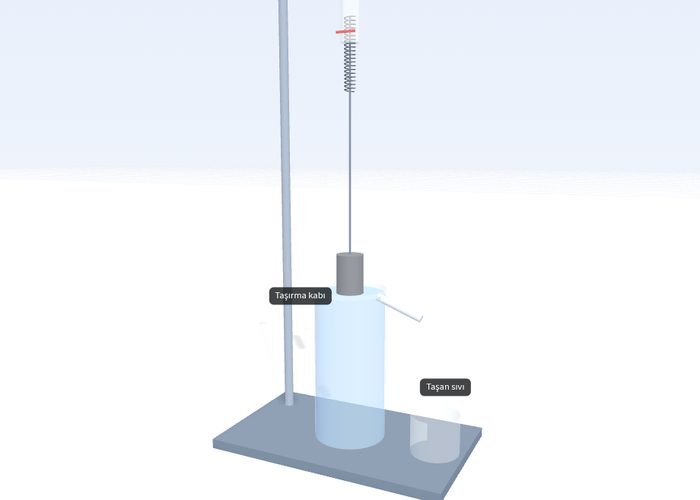
Explore the buoyant force exerted by liquids on objects with the buoyant force variables simulation using Archimedes' principle. In this interactive experiment, you will test different objects such as an aluminum cylinder, iron cylinder, pure gold ingot, and a crown using a spring scale and overflow can. By observing the effects of submerged volume, liquid density, and gravitational acceleration on the buoyant force, you can easily perform physics laboratory experiments right in your browser.
What can you do in this simulation?
- You can observe the effect of submerged volume on buoyant force by submerging the aluminum and iron cylinders into water halfway or completely.
- You can examine the role of liquid density on the buoyant force by taking measurements in different liquids.
- You can compare the relationship between materials and buoyant force by testing a pure gold ingot and King Hiero's crown.
- You can receive instant feedback by following spring scale readings and making predictions.
Basic concepts and formulas
The buoyant force acting on an object immersed in a liquid is created by the liquid pushing the object upward against gravity. According to Archimedes' principle, this force is equal to the weight of the fluid displaced by the object. Our fundamental formula is F_b = V_sub · d_liquid · g. Here, F_b represents the buoyant force, V_sub the submerged volume, d_liquid the liquid density, and g the gravitational acceleration.
How to use?
- Follow the guide on the experiment screen, select the objects, and measure their weights in air using the spring scale.
- Submerge the object halfway or completely into the water using the overflow can.
- Record the values you read on the spring scale and the amount of overflowing liquid.
- Repeat the steps by selecting different liquids or different materials (gold ingot and crown) and compare the results.
Frequently asked questions
Is the buoyant force dependent on the submerged volume?
Yes, as the volume of the object submerged in the liquid increases, the amount of displaced liquid also increases, so the acting buoyant force increases in direct proportion.
How does liquid density affect the buoyant force?
Liquids with higher density apply more buoyant force to objects of the same volume because the liquid weight per unit volume is greater.
What does King Hiero's crown experiment show us?
This classic story-based experiment proves that pure gold and a different metal of the same mass will have different volumes and therefore experience different buoyant forces.
 Interactive experiment