Convex polygons: discover the sum of interior angles (n−2)·180°, sum of exterior angles 360°, number of diagonals n(n−3)/2 and an interior angle of a regular polygon by changing the number of sides; partitioning into triangles using diagonals drawn from a single vertex
You can examine this convex polygons simulation to discover the properties of convex polygons and reinforce the topic of geometric shapes. Thanks to this interactive experiment, you can learn basic formulas such as the sum of interior angles, sum of exterior angles, and number of diagonals interactively by changing the number of sides.
What can you do in this simulation?
You can examine different convex polygons by changing the number of sides.
You can switch between n different side values and different views.
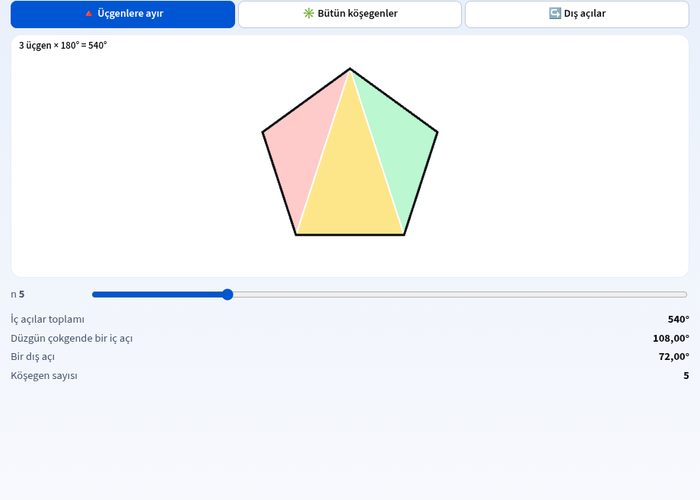
You can observe the polygon being divided into triangles by diagonals drawn from a vertex.
You can calculate the sum of interior angles, sum of exterior angles, and the measure of an interior angle.
You can test your knowledge by answering questions accompanied by a guide.
Basic concepts and formulas
In geometry, the sum of interior angles of a convex n-gon is given by the formula (n - 2)·180°. The sum of exterior angles is always 360°. Diagonals drawn from a single vertex divide the polygon into n - 2 triangles, and the total number of diagonals is calculated as n(n - 3) / 2. In regular polygons, an interior angle is found by the formula ((n - 2)·180°) / n.
How to use?
Select the number of sides (n) and the view mode via the experiment panel.
Examine the changes on the polygon and how it splits into triangles.
Answer the questions by following the guide's instructions.
Check your predictions and review the results.
Frequently asked questions
Is the sum of exterior angles of convex polygons always 360 degrees?
Yes, no matter how many sides there are, the sum of exterior angles of all convex polygons is constant and is 360°.
How do you find the number of diagonals in a polygon?
In an n-gon, n - 3 diagonals can be drawn from a single vertex, and the total number of diagonals is calculated with the formula n(n - 3) / 2.
Where does the formula for the sum of interior angles come from?
The diagonals drawn from a single vertex of a polygon divide the shape into n - 2 triangles. Since the sum of interior angles of each triangle is 180°, the formula is derived this way.
 Interactive experiment