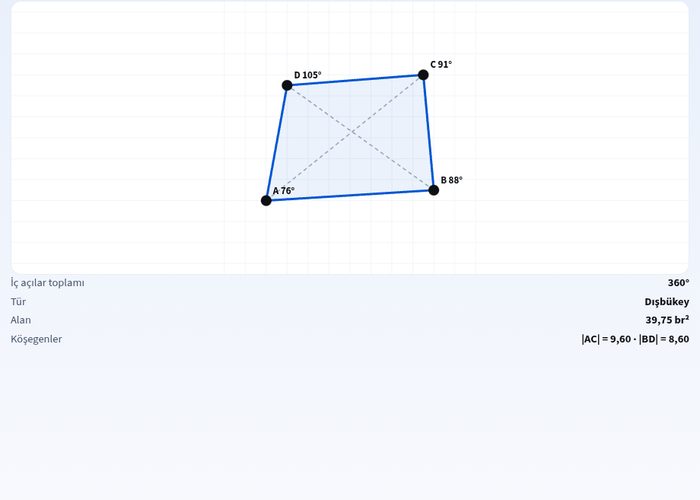
Quadrilateral laboratory: drag the four vertices; discover that the sum of interior angles is 360°, the intersection of diagonals, that side midpoints form a parallelogram (Varignon's theorem) and how to calculate area using diagonals; convex and concave quadrilaterals
Would you like to interactively explore the properties of quadrilaterals as you step into the world of geometry? With this properties of quadrilaterals simulation, you can examine quadrilaterals and easily learn about the sum of interior angles and diagonal relationships. It is a fantastic digital laboratory to reinforce the topic of geometric shapes in high school math class.
What can you do in this simulation?
You can create different quadrilateral shapes by dragging the four corners as you wish.
You can examine the structural differences between convex and concave quadrilaterals.
You can observe that the sum of interior angles is always 360°.
You can discover the Varignon parallelogram with the show midpoint quadrilateral option.
You can answer questions step-by-step guided by the instructions and test your knowledge.
Basic concepts and formulas
In any convex or concave quadrilateral, the sum of interior angles is based on a fixed rule: Sum = 360°. Additionally, connecting the side midpoints of a quadrilateral always yields a parallelogram (Varignon's Theorem).
How to use?
Open the Quadrilateral Laboratory screen and move the corners with a mouse or finger touch.
Create different shapes and monitor the changes in the sum of interior angles and diagonals.
Observe the Varignon parallelogram by turning on the midpoint quadrilateral mode.
Answer the questions in the guide and restart the experiment to repeat different scenarios.
Frequently asked questions
Is the sum of interior angles always 360 degrees in every quadrilateral?
Yes, whether convex or concave, the sum of interior angles always yields 360° in all quadrilaterals.
What is the Varignon parallelogram?
The new shape formed when the midpoints of the sides of any quadrilateral are connected is always a parallelogram.
What is the difference between a concave quadrilateral and a convex quadrilateral?
In a concave quadrilateral, the measure of at least one interior angle is greater than 180° and the shape has an inward indentation, whereas in a convex one, all interior angles are less than 180°.
 Interactive experiment