Classify polygons: name by number of sides, separate into convex–concave and regular–irregular; see concavity and the diagonal test by pushing a vertex of a polygon inward
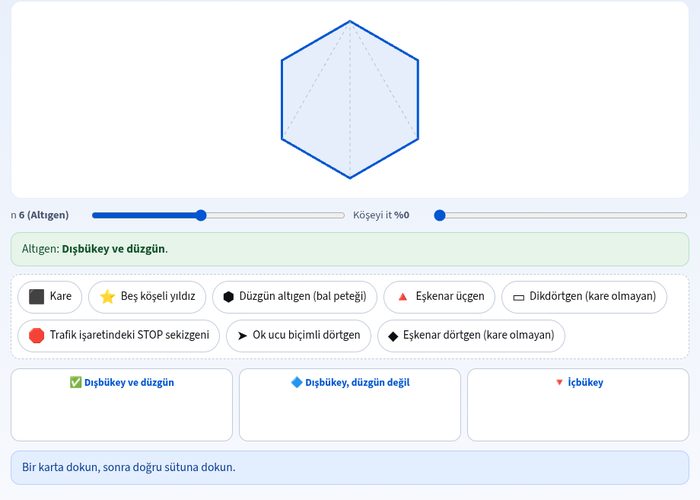
Discover the properties of geometric shapes with the Classification of Polygons simulation and learn to sort them by their number of sides, and whether they are concave or regular. Through this interactive experiment, you can reinforce the fundamental traits of polygons using interactive cards.## What you can do in this simulation:- You can drag and drop shapes into the appropriate boxes according to their number of sides and properties.- You can examine the boundaries between convex and concave polygons, and observe concavity by pushing a vertex inward.- You can distinguish between regular and irregular polygons and discover the key differences between them.- You can get instant feedback on correct or incorrect answers and complete your missing areas with the help of a guide.## Basic concepts and formulasIn geometry, polygons are closed shapes formed by end-to-end joining of at least three line segments. If the number of sides is called n, the sum of interior angles of a convex n-gon is calculated using the Formula: (n - 2) · 180°. Polygons whose all sides and interior angles are equal are called regular polygons. Those with at least one interior angle measuring greater than 180 degrees are classified as concave polygons.## How to use?1. Come to the experiment panel and carefully examine the cards.2. Tap a card or drag and drop it into its respective box.3. Validate your answers by pressing the check button and get instant feedback.4. Repeat the experiment from the beginning by following the guide's hints on steps where you fell short.## Frequently asked questions### What is the difference between a regular polygon and an irregular polygon?A regular polygon has both all side lengths and all interior angle measures equal to each other. Shapes like rhombuses or rectangles are not considered regular because they only satisfy one property.### What is a concave polygon and how is it recognized?If at least one interior angle of a polygon is greater than 180 degrees and the shape contains an inward indentation, this structure is called a concave polygon.### How is the sum of interior angles of polygons found?The sum of interior angles of a polygon with n sides can be easily calculated using the formula (n - 2) times 180.
 Interactive experiment