Family of special quadrilaterals: transform a parallelogram into a rectangle, rhombus and square by playing with side lengths and angles; fill out the property table and examine the hierarchy diagram of special quadrilaterals
If you want to discover the relationship and hierarchy among special quadrilaterals, this interactive simulation is just for you. By changing side lengths and angles, you can observe how a parallelogram transforms into a rectangle, a rhombus, and a square. In this geometry experiment, you will learn subclass relationships between special quadrilaterals by filling out the property table.
What can you do in this simulation?
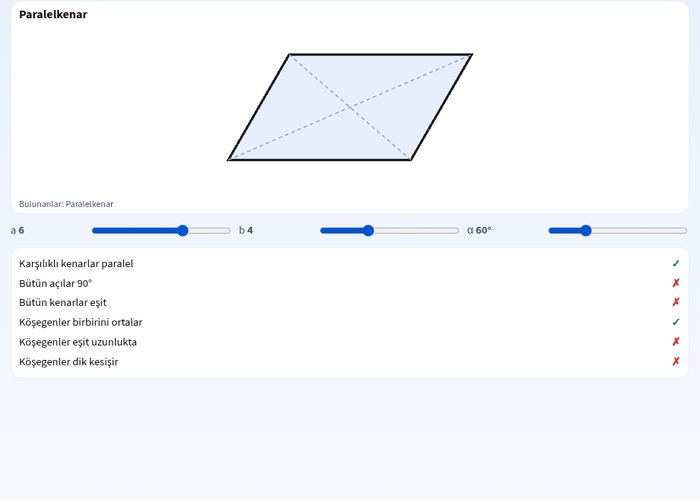
You can transform the shape of the parallelogram by changing side lengths a and b and angle alpha.
You can examine properties such as the parallelism of opposite sides, all angles being 90 degrees, and the equality of all sides.
You can test whether diagonals are of equal length, whether they bisect each other, and whether they intersect perpendicularly.
You can fill out the property table by dragging and dropping cards into appropriate boxes or by tapping.
You can follow step-by-step transformation stages and the hierarchy diagram of special quadrilaterals.
Basic concepts and formulas
Special quadrilaterals carry all the properties of shapes that are their subsets. For example, a square is a special parallelogram that satisfies the properties of both a rectangle and a rhombus. While the parallelogram area formula is Area = a · h (base times height), it is Area = a² for a square and Area = a · b for a rectangle. For quadrilaterals whose diagonals intersect perpendicularly, the area can also be calculated using the formula e·f/2.
How to use?
Open the experiment panel and examine the controls on sides a, b, and angle alpha.
Turn the parallelogram into a rectangle, rhombus, or square by changing side and angle values.
Examine the properties and match them by dragging and dropping cards into the correct boxes.
Check the results in the table and reinforce hierarchical relationships by following the guide steps.
Frequently asked questions
Is every square a rectangle?
Yes, all interior angles of a square are 90 degrees and its opposite sides are parallel, which ensures it fits the definition of a rectangle.
What is the difference between a rhombus and a square?
In a rhombus, all side lengths are equal, but interior angles do not have to be 90 degrees; a square has both equal sides and 90-degree angles.
What features of special quadrilaterals does a parallelogram encompass?
A parallelogram is a member of the trapezoid family thanks to the parallelism of its opposite sides, but it forms the fundamental superset of all special quadrilaterals (rectangle, rhombus, square).
 Interactive experiment