Theme 2: Geometric Shapes
grade 11 mathematics · theme 2
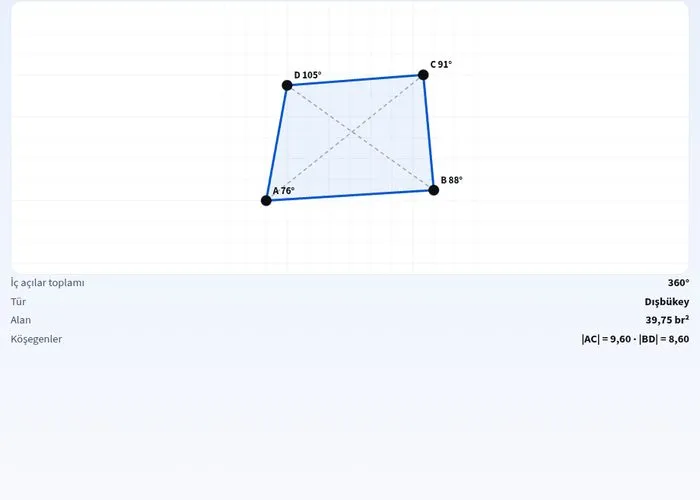
2.1 Properties of Quadrilaterals
Quadrilateral laboratory: drag the four vertices; discover that the sum of interior angles is 360°, the intersection of diagonals, that side midpoints form a parallelogram (Varignon's theorem) and how to calculate area using diagonals; convex and concave quadrilaterals
Open Simulation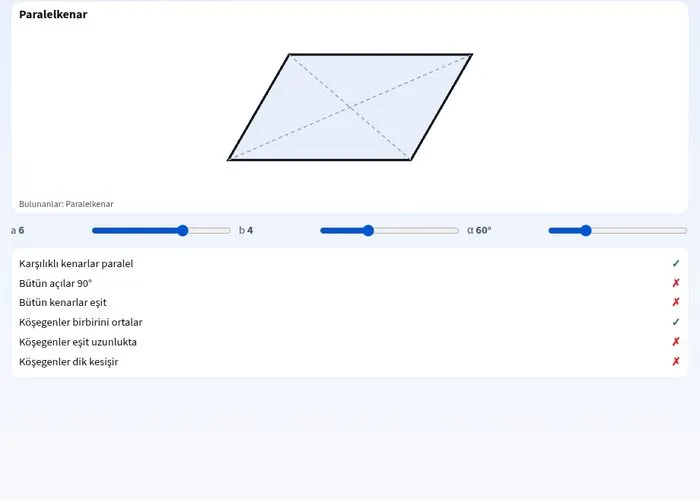
2.2 Relationships Among Special Quadrilaterals
Family of special quadrilaterals: transform a parallelogram into a rectangle, rhombus and square by playing with side lengths and angles; fill out the property table and examine the hierarchy diagram of special quadrilaterals
Open Simulation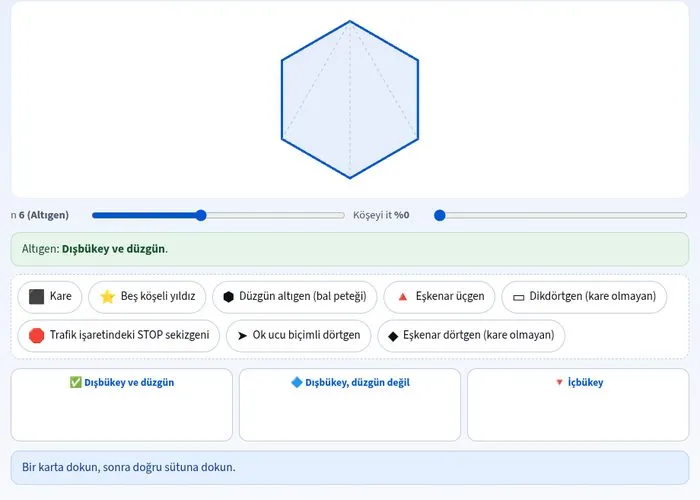
2.3 Classification of Polygons
Classify polygons: name by number of sides, separate into convex–concave and regular–irregular; see concavity and the diagonal test by pushing a vertex of a polygon inward
Open Simulation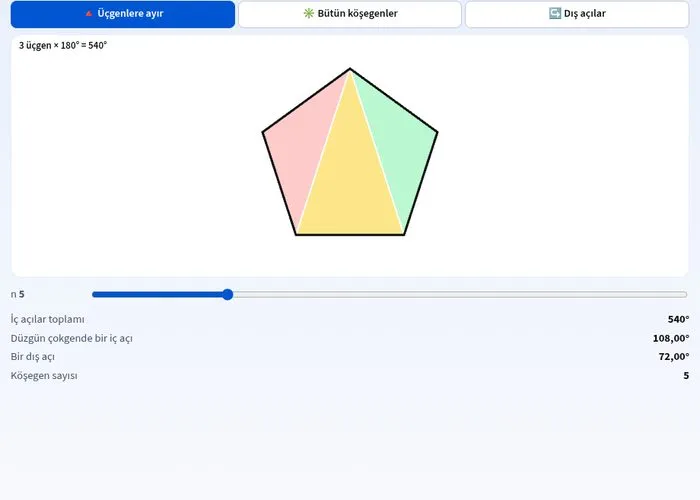
2.4 Properties of Convex Polygons
Convex polygons: discover the sum of interior angles (n−2)·180°, sum of exterior angles 360°, number of diagonals n(n−3)/2 and an interior angle of a regular polygon by changing the number of sides; partitioning into triangles using diagonals drawn from a single vertex
Open Simulation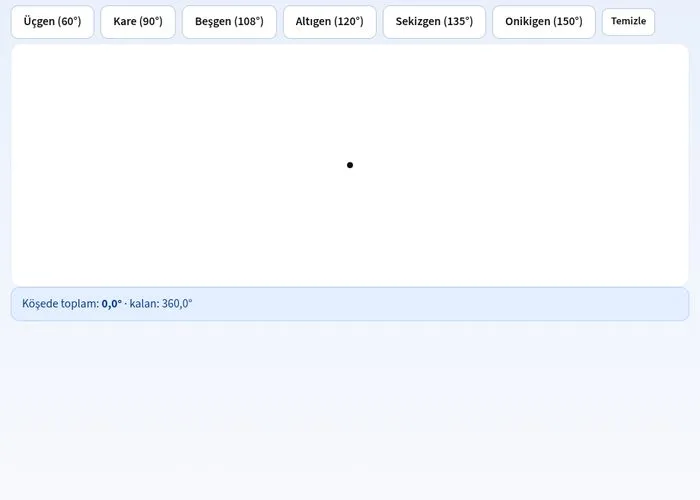
2.5 Problems Involving Polygons
Tessellation with polygons: find tilings where the sum of angles around a vertex is 360° by placing regular polygons around it; demonstrate that only triangles, squares and hexagons alone can tile the plane; calculate the area of a regular polygon
Open Simulation