Problem solving with functions: largest rectangular garden with 40 m of wire (quadratic model), solving equations and inequalities through the intersection of two function graphs
You can easily learn abstract mathematical models over concrete scenarios with the equations and inequalities with functions problems simulation. This interactive tool allows you to reinforce the theme of quantities and change in the 10th grade mathematics curriculum and improve your problem-solving skills with function graphs. You can practice with scenarios such as maximizing a garden area or finding the intersection points of graphs.
What can you do in this simulation?
You can follow the steps of problem solving with functions through interactive cards and guiding questions.
You can reach the correct result by recording your guesses and testing them instantly on the experiment panel.
You can improve your thinking skills where you get stuck with the tips of the guide mascot.
You can check your calculations with correct and incorrect answer feedbacks.
You can reset the steps with the restart button and retry different scenarios.
Basic concepts and formulas
Linear and quadratic functions are used to model changes in mathematical problems. For example, the sides of the rectangle with the largest possible area that can be formed with a wire of fixed perimeter are expressed by the quadratic model f(x) = x·(20 - x). The intersection points of two functions give the roots of the equation f(x) = g(x), and inequalities give the intervals where the graphs remain above or below each other.
How to use?
Go to the experiment panel and carefully read the mathematical problem or scenario presented to you.
Place the cards into the relevant boxes by dragging and dropping or by tapping.
Enter your prediction and test your answer by clicking the check button.
Review the feedback to correct your missing or incorrect steps.
Move to other stages using the forward or restart buttons.
Frequently asked questions
Where should I start when solving problems with functions?
First, you should define the unknowns given in the problem depending on a variable (usually x) and set up the function model appropriate for the situation.
How is the maximum area problem solved?
A second-degree function is obtained, and the largest value is found with the help of the ordinate (k value) of the vertex of this parabola or the derivative/axis of symmetry.
What does the intersection point of graphs mean?
The point where the graphs of two functions intersect gives the (x, y) pair that satisfies both equations simultaneously, namely the common solution.
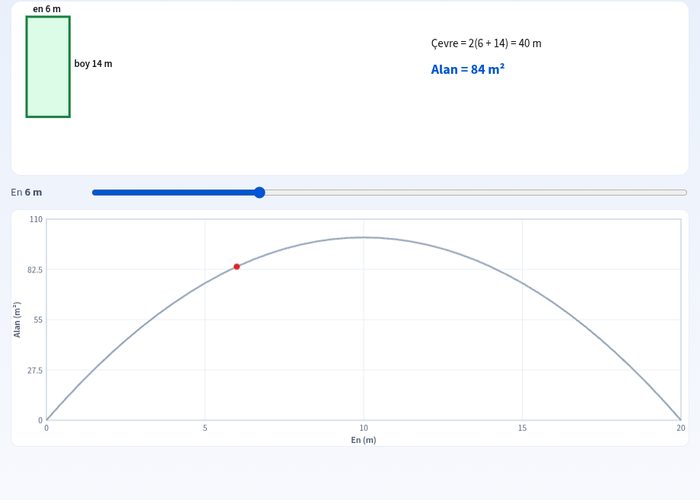 Interactive experiment