Inverse functions: view the inverses of linear, quadratic (x ≥ 0), square root and rational functions as reflections across the line y = x; condition of being one-to-one and onto; f(f⁻¹(x)) = x
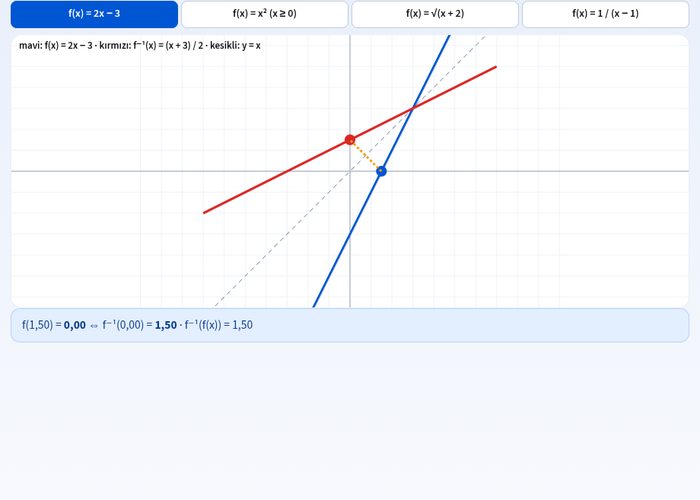
Explore the inverses of linear, quadratic, square root, and rational functions with the inverse functions simulation. In this interactive experiment, you will visually learn that the inverse of a function is its symmetry with respect to the line y = x.
What can you do in this simulation?
You can examine four different types of functions (linear, quadratic, square root, rational) in detail.
You can see how points (a, b) on function graphs transform into points (b, a) in the inverse function.
You can answer questions testing the conditions of being one-to-one and onto.
You can reinforce your knowledge by dragging and dropping cards or placing them in boxes.
With the help of a step-by-step guide, you can check correct answers and review areas where you made mistakes.
Basic concepts and formulas
The inverse of a function f is denoted by f⁻¹. When f(x) = y, the relation f⁻¹(y) = x holds. The composition of the function and its inverse gives the identity function: f(f⁻¹(x)) = x and f⁻¹(f(x)) = x. Graphically, the graphs of f and f⁻¹ are symmetric with respect to the line y = x.
How to use?
Go to the experiment panel and select the function to be examined.
Follow the guide to examine the properties and graphs of the functions.
Answer the questions and test them experimentally by recording your predictions.
Complete the matches by dragging and dropping the cards into the appropriate boxes or columns.
Repeat the experiment with different functions using the restart button.
Frequently asked questions
What condition is required for a function to have an inverse?
For a function to have an inverse, it must be both one-to-one and onto. Functions that are not one-to-one do not define an inverse function.
How is the graph of an inverse function obtained?
The graph of the inverse function is obtained by reflecting the original function's graph across the line y = x. This operation means swapping the x and y coordinates.
Is f(f⁻¹(x)) always equal to x?
Yes, for appropriate x values in the domain, the composition of a function and its inverse is always equal to the identity function x.
 Interactive experiment