Three-domain system: Bacteria, Archaea, Eukaryotes (protists, plants, fungi, animals). Who Am I? game and feature comparison of domains
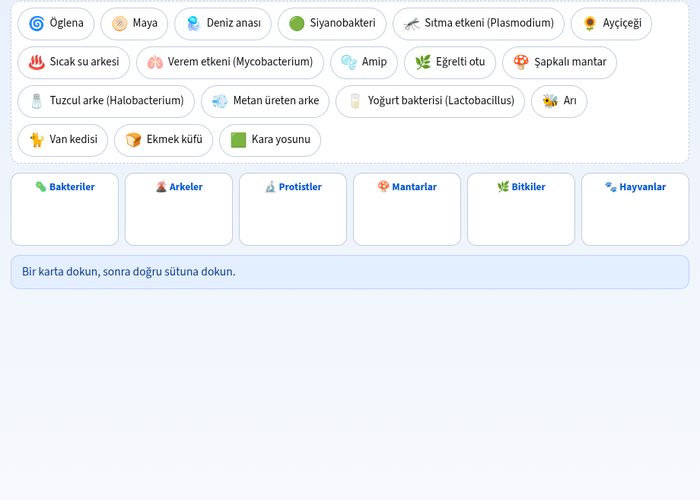
Discover the basic characteristics of the Bacteria, Archaea, and Eukaryotes groups with the organisms included in the three-domain system simulation through an interactive "Who Am I?" game. In this activity, you will examine 18 different organisms such as yogurt bacterium, halophilic archaeon, Euglena, and mushroom, and learn to place them into the correct categories.
What can you do in this simulation?
- You can place the 18 different organism cards into the corresponding domain boxes by tapping or dragging and dropping.
- You can observe the differences in nuclear membrane, membrane-bound organelles, and cell walls among Bacteria, Archaea, and Eukaryotes (protists, plants, fungi, animals).
- You can examine the biological structures of the groups via the feature comparison table.
- You can instantly check your matches to see the correct results and repeat the experiment using the restart button.
Basic concepts and formulas
The classification of living things is based on the "Three-Domain" system proposed by Woese and colleagues in modern biology. This system divides life into three main groups according to cell structure, ribosomal RNA sequences, and membrane structures:
- Bacteria: Unicellular organisms that have a prokaryotic cell structure and contain peptidoglycan in their cell walls.
- Archaea: Organisms that, despite being prokaryotic, are genetically and metabolically distinct from bacteria and can generally live in extreme conditions.
- Eukaryotes: The domain encompassing protists, plants, fungi, and animals, which possess a membrane-bound nucleus and organelles.
How to use?
- Tap on one of the organism cards presented in the "Who Am I?" game that opens on the experiment screen.
- Place it by tapping the domain column or box where you think the card belongs.
- Make sure you have placed all blanks and organisms into the correct groups.
- Verify your answers by clicking the check button and review your missing points.
Frequently asked questions
Why are Archaea examined in a separate domain from bacteria?
Although Archaea resemble bacteria in outward appearance, their genetic structures, ribosomal RNA sequences, and cell wall chemistries are more similar to eukaryotes.
Are all bacteria pathogenic?
No, a very small fraction of bacteria are pathogens. Most bacteria play a role in nutrient cycling in nature and vital processes such as digestion.
Which organism groups are included in the eukaryote domain?
This group includes both unicellular and advanced multicellular organisms such as protists, plants, fungi, and animals.
 Interactive experiment