Classification: binomial nomenclature, classification categories; identify 6 organism step by step using a dichotomous key
Interactively explore taxonomic categories and biodiversity in biology with the Basic Approaches in Classification and Modern Classification simulation. In this experiment, by grasping the principles of binomial nomenclature, you will identify 6 different organisms step by step with the help of a dichotomous key and improve your classification skills.
What can you do in this simulation?
- You can examine classification categories from the domain level down to the species level.
- You can place the cards into the correct boxes by dragging and dropping or by touching.
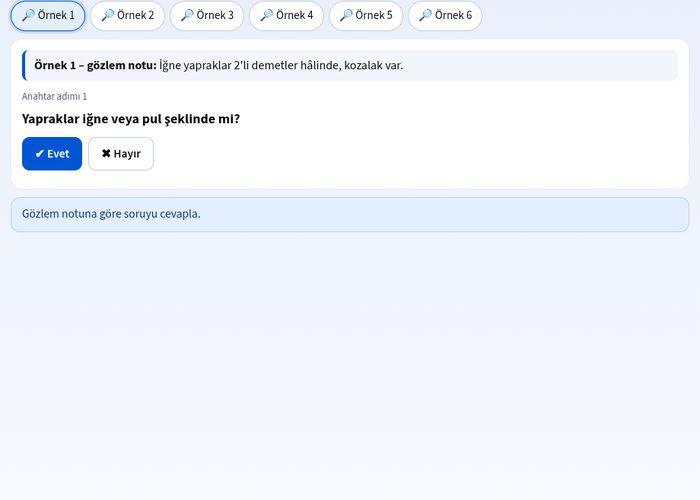
- By answering dichotomous key questions, you can distinguish organisms such as Turkish pine, Uludağ fir, Anatolian fritillary, and dog rose.
- You can classify organisms according to leaf and flower characteristics (needle-like leaf, scale-like leaf, lobed leaf, woody stem).
- You can check your correct answers accompanied by the guide and make use of hints where you get stuck.
Basic concepts and formulas
The classification of living things is based on the examination of common characteristics and degrees of relatedness. In modern taxonomy, species is the smallest classification unit and is a group of individuals that can mate under natural conditions to form fertile offspring. A dichotomous key, on the other hand, is an analytical tool that allows identifying organisms by stepping them apart based on two contrasting characters (e.g., "are the leaves needle-shaped?" yes/no).
How to use?
- Go to the experiment panel and read the classification questions and instructions.
- Touch the cards or sample organisms and place them in the relevant boxes or columns.
- Answer questions in the key such as "Are leaves needle- or scale-shaped?" with yes or no options.
- After filling in all the blanks, check your answers and review the guide's feedback.
Frequently asked questions
What is the purpose of a dichotomous key?
A dichotomous key is a practical guide that allows you to reach the correct species and name of an organism found in nature by eliminating it step by step using two-choice questions.
What is the concept of species?
A species is a group of organisms that share a common ancestor, have similar morphological and anatomical features, and can mate under natural conditions to produce fertile offspring (non-sterile offspring).
How are classification categories ordered from largest to smallest?
Categories are ordered from largest to smallest as Domain, Kingdom, Phylum, Class, Order, Family, Genus, and Species.
 Interactive experiment