Cell membrane simulation: O₂ diffusion, transport of glucose via carrier protein, water (osmosis), active transport with Na⁺–K⁺ pump, and endocytosis; monitor with concentration difference and ATP
Interactively explore the selectively permeable structure of the cell membrane, the movement of molecules, and energy utilization mechanisms with the Substance Transport Across the Cell Membrane simulation. This experiment allows you to reinforce the fundamentals of biology by observing all types of substance exchange from simple to complex. You can speed up your learning process by examining the factors affecting intracellular and extracellular balance.
What can you do in this simulation?
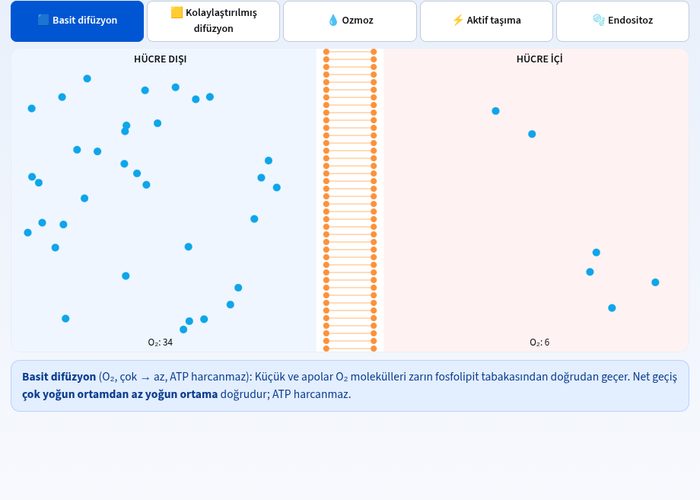
You can observe simple diffusion, facilitated diffusion, and osmosis events depending on the concentration difference.
You can operate the active transport mechanism with the help of the Na⁺–K⁺ pump and examine the expenditure of ATP.
You can track molecule passages between extracellular and intracellular environments step by step.
You can test the differences between transport that requires energy and transport that does not by turning the ATP switch on and off.
You can match the transport types by placing the cards into the appropriate boxes and instantly test your knowledge.
Basic concepts and formulas
For living organisms to survive, continuous substance exchange takes place across the cell membrane. In passive transport events (simple diffusion, facilitated diffusion, osmosis), molecules move with their own energy from a high concentration environment to a low concentration environment (along the concentration gradient) and ATP is not expended. In active transport, however, molecules are transported from a low concentration environment to a high concentration environment, and ATP is definitely expended. Energy consumption is explained by diffusion flux equations such as J = -D·(dc/dx) and the kinetics of membrane proteins.
How to use?
Go to the experiment panel and start the cell membrane simulation.
Choose one of the options: simple diffusion, facilitated diffusion, osmosis of water, or active transport.
Adjust the energy status using the ATP switch and observe the movement of molecules.
Answer the questions in the guide, complete the matches by dragging and dropping the cards into the appropriate boxes.
Compare the results of different transport types by repeating the steps.
Frequently asked questions
What is the difference between simple diffusion and facilitated diffusion?
While simple diffusion occurs through the direct passage of small and nonpolar molecules across the membrane, facilitated diffusion allows large or polar molecules to pass with the help of carrier and channel proteins; ATP is not expended in either.
Why is ATP expended in active transport?
Since molecules are transported against their concentration gradient (from a low concentration medium to a high concentration medium), it is mandatory for the cell to expend energy (ATP).
What is osmosis and for which molecules does it apply?
Osmosis is the diffusion of water molecules from a region of higher concentration to a region of lower concentration through a semipermeable membrane and applies only to water.
 Interactive experiment