Cell explorer: touch organelles in bacterial, animal, and plant cells; find the organelle whose task is given; prokaryote–eukaryote comparison and cell model
You can learn biology topics interactively with this cell explorer simulation, which allows you to discover the relationships between the cell and its sub-units. By examining different cell types such as bacterial, animal, and plant cells, you can directly observe the functions and structures of organelles. You will grasp the fundamental differences between prokaryotic and eukaryotic cells and have the opportunity to practice the workings of intracellular organization.
What can you do in this simulation?
You can switch between bacterial, animal, and plant cells to examine the structures belonging to each cell type.
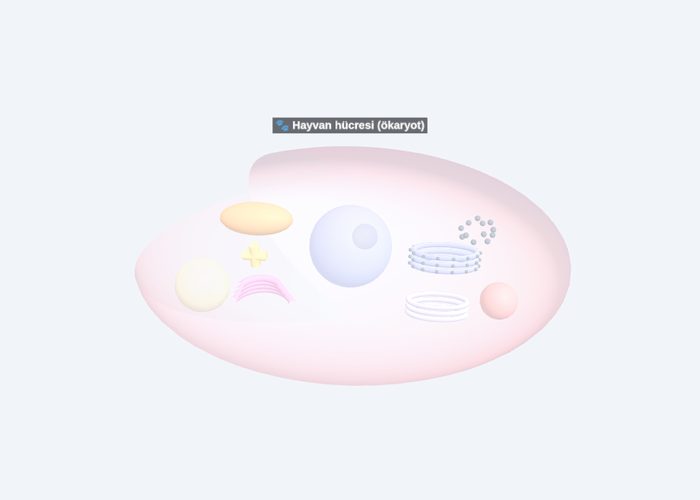
You can learn the functions of organelles such as the cell membrane, cell wall, nucleus, mitochondria, endoplasmic reticulum, and Golgi apparatus by touching them.
You can solve card-matching puzzles by finding the correct organelle according to the hints and questions given in task mode.
You can discover prokaryotic features such as circular DNA and nucleoids in bacteria.
You can compare structures like the central vacuole and chloroplast in a plant cell with the centrosome in an animal cell.
Basic concepts and formulas
Cells, which are the structural units of living things, are divided into two groups: prokaryotic and eukaryotic. While prokaryotic cells like bacteria lack membrane-bound organelles and a distinct nucleus, eukaryotic cells like plant and animal cells contain membrane-bound organelles and a true nucleus. Intracellular organelles work as a system; for example, cell metabolism is carried out through the process of protein synthesis (Ribosome) -> transport (Rough ER) -> packaging (Golgi).
How to use?
Select the cell type you want to examine (bacterial, animal, or plant) from the cell explorer screen.
Read the functions of organelles and structures by touching them on the cell.
Open task mode and start the puzzle of finding the requested organelle or structure.
Place the cards into the appropriate boxes by dragging or tapping them, and check your answers.
Frequently asked questions
What is the main difference between prokaryotic and eukaryotic cells?
While prokaryotic cells lack a nuclear membrane and membrane-bound organelles, eukaryotic cells have their DNA located inside a nucleus and feature advanced membrane-bound organelles.
Are plant and animal cell organelles completely the same?
No, plant cells contain a cell wall, chloroplasts, and a central vacuole; whereas animal cells do not have a cell wall and contain centrosomes involved in cell division.
How do organelles establish a relationship within the cell?
Organelles work together to carry out vital activities such as substance production, energy production (ATP), packaging, and transport in a coordinated manner.
 Interactive experiment