Diffusion and osmosis experiment: place potato cylinders in different salt concentrations, measure mass change and find the isotonic point from the graph; cells in hypotonic/isotonic/hypertonic environments
With the diffusion and osmosis experiment simulation, you can measure mass change by placing potato sticks in different salt concentrations and interactively learn the rules of passive transport across the cell membrane. In this simulation, you observe the effects of hypotonic, isotonic, and hypertonic environments on the cell and perform graphical analyses. It is a great tool to reinforce 9th-grade topics in biology.
What can you do in this simulation?
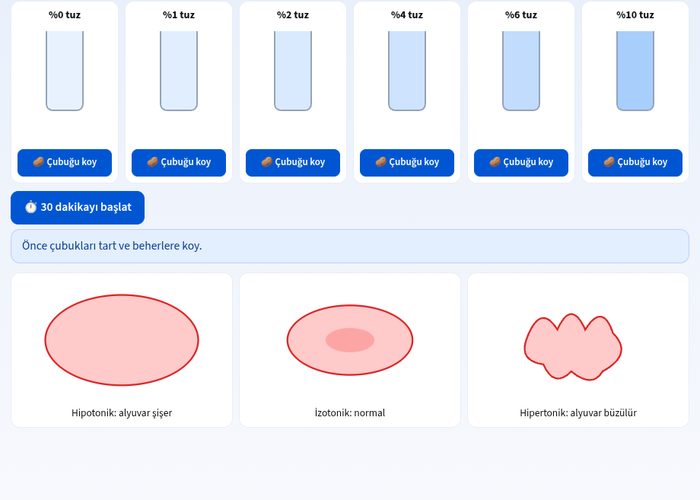
You can place potato sticks into six beakers with different salt concentrations.
You can calculate the percentage mass change by taking the initial and final mass measurements of the sticks.
You can find the isotonic point from the graph showing the relationship between salt concentration and mass change.
You can examine how red blood cells react in different environments (for example, distilled water or saltwater) and the phenomenon of hemolysis.
You can test the concepts of passive transport, diffusion, and osmosis by answering questions step by step accompanied by the guide.
Basic concepts and formulas
Passive transport is the passage of substances across the cell membrane from a high concentration environment to a low concentration environment without spending energy (consuming ATP). Osmosis is the diffusion of water through a semipermeable membrane from the side where it is abundant to the side where it is less. In an isotonic environment, intracellular and extracellular concentrations are equal; in a hypotonic environment, the cell taking in water swells, whereas in a hypertonic environment, it shrinks by losing water. Percentage mass change is calculated with the following formula: Percentage Change = ((Final Mass - Initial Mass) / Initial Mass) · 100.
How to use?
Open the experiment panel, follow the guide, and place the potato sticks into beakers of different concentrations.
Wait for the time to pass and measure the final masses of the potatoes in all six beakers one by one.
Match the dependent and independent variables by examining the measurement data and mass change graphs.
Answer the questions, check your correct and incorrect answers, and review the steps where you are deficient.
Frequently asked questions
Why does the mass of the potato not change at the isotonic point?
Since the intracellular and extracellular solution concentrations are equal to each other at the isotonic point, the amount of water entering and leaving the cell is balanced and no net mass change is observed.
Why does the potato stick lose water in a hypertonic medium?
Since the salt concentration of the hypertonic medium is higher than that inside the cell, water goes out according to the rules of osmosis, and the potato loses mass and shrinks.
What are the independent and dependent variables in this experiment?
In this experiment, the salt concentration is the independent variable, while the resulting mass change of the potato is the dependent variable.
 Interactive experiment