Square root of decimal expressions and real numbers: find the square root of decimals like 0,49 by converting them to fractions; transfer √2 to the number line using a compass with the diagonal of a unit square; place numbers into rational and irrational sets
Are you ready to discover number sets in mathematics with the square roots of decimals and real numbers simulation? This interactive experiment makes it fun to find the square root of decimal numbers with the help of fractions, represent square roots on the number line using the diagonal of a unit square, and classify numbers. You will learn the basic math rules you will encounter during your LGS preparation process by practicing.
What can you do in this simulation?
You can convert decimal numbers into rational form and calculate their square roots.
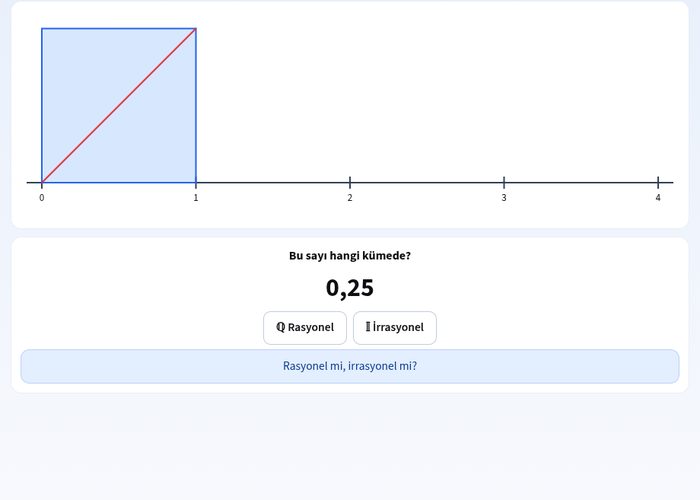
You can find the diagonal length of a unit square and transfer it to the number line.
You can place different numbers by dragging and dropping them into their rational and irrational sets.
You can solve questions guided by the mentor and get instant feedback.
You can check your wrong answers and repeat the steps.
Basic concepts and formulas
When taking the square root of decimal expressions, the number is first converted into a fraction: √(0,49) = √(49/100) = 7/10 = 0,7. The set of real numbers (R) consists of the union of rational numbers (Q) and irrational numbers (Q'). Using the Pythagorean theorem, the diagonal of a unit square is calculated as c = √(1² + 1²) = √2, and this length is transferred to the number line using a compass.
How to use?
Open the experiment and read the guide's instructions.
Examine the cards and numbers and move them to the relevant boxes or columns.
Verify your guesses by clicking the check answers button.
If necessary, review incorrect answers and try again from the beginning.
Frequently asked questions
How do you take the square root of decimal expressions?
The number is first written as a fraction, and then the result is found by taking the square roots of the numerator and denominator separately.
Which sets make up real numbers?
All rational numbers and irrational numbers together form the set of real numbers.
How are square root numbers represented on the number line?
The diagonal length of geometric shapes (for example, a unit square) is found and transferred to the number line.
 Interactive experiment