Perfect squares and square root: build the largest possible square using unit squares, discover perfect square numbers; estimate which two whole numbers the square root of a non-perfect square lies between on a number line
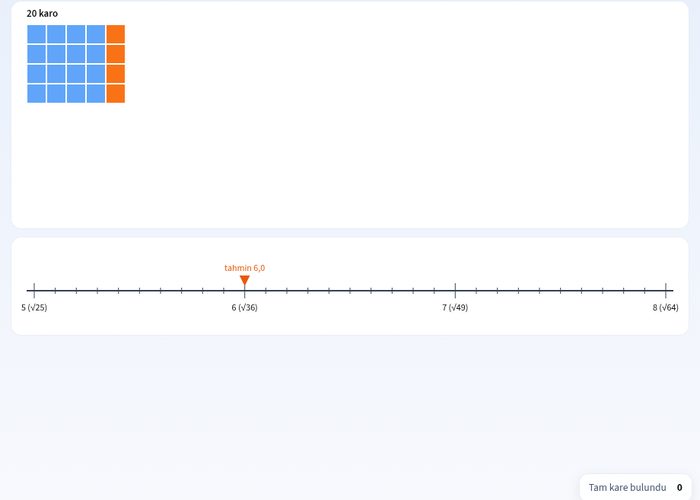
With the Perfect Squares and Square Roots simulation, you can interactively reinforce the topic of square root expressions in 8th grade mathematics. In this fun experiment, you will discover perfect square numbers by building the largest square with unit squares and learn to estimate which two consecutive natural numbers non-perfect square numbers lie between on the number line.
What can you do in this simulation?
You can discover area relationships that form perfect square numbers by using unit squares.
You can match the given cards by dragging and dropping them into the correct boxes or by tapping.
You can estimate which two natural numbers a non-perfect square number (for example, square root of 40) lies between.
You can review your incorrect answers by following the guide mascot's tips and track your score from the experiment panel.
You can test your estimation skill again by resetting the steps with the Restart button.
Basic concepts and formulas
Perfect square numbers are numbers that are the square of a natural number (such as 1, 4, 9, 16, 25). The square root of these numbers is equal to an integer, for example √16 = 4. As for the square roots of non-perfect square numbers, the result lies between two consecutive natural numbers. For example, the number √40 is between √36 (6) and √49 (7), and it is estimated which integer it is closer to.
How to use?
Open the experiment, read the guide's instructions, and examine the cards on the screen.
Place a card into the relevant box or column by tapping it or dragging and dropping it.
Enter your estimate, click the Check button, and see your result.
If necessary, continue with the Next step or repeat the simulation by clicking the Restart button.
Frequently asked questions
What is a perfect square number?
Numbers obtained by multiplying an integer by itself are called perfect square numbers; for example, since 5 x 5 = 25, 25 is a perfect square number.
How do you find which two numbers a square root lies between?
The nearest perfect square numbers immediately below and above the given number are determined; by taking the square roots of these two perfect square numbers, the number interval in between is found.
What happens if I make a mistake in the simulation?
You can check your calculation by reading the guide's tips and explanations, go back to the steps you found difficult, and repeat the experiment.
 Interactive experiment