Operations with square root expressions: simplify √72 into the form a√b by extracting perfect square factors; add like square root terms; multiply and divide square root expressions, rationalize the denominator
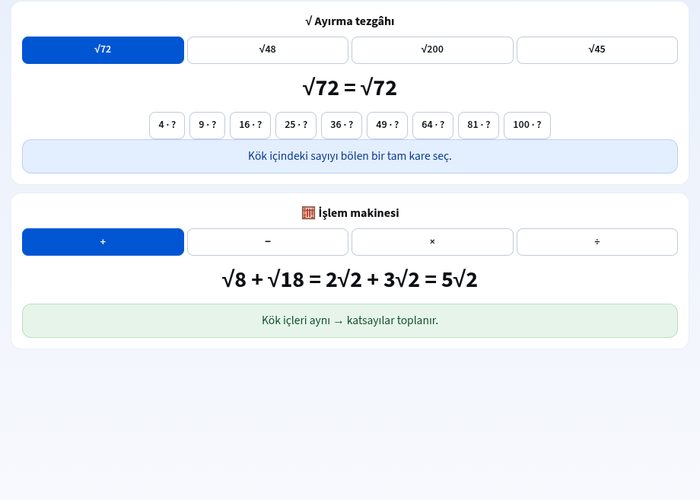
You can interactively learn how to convert radical numbers into a√b form, and perform addition, subtraction, multiplication, and division with like terms using the Operations with Square Roots simulation. In this fun application, you will discover how to simplify expressions like √72 by factoring out perfect square factors and reinforce your math skills. You can practice question types you might encounter during the LGS preparation process and experience the steps at your own pace.
What can you do in this simulation?
You can convert numbers into a√b format by factoring them into their perfect square components.
You can see the ease of completing operations in a single step by choosing the largest perfect square factor.
You can realize the importance of like radicals when adding and subtracting square root expressions.
You can examine the results by applying multiplication and division operations.
You can check the correct answers with the guidance of a tutor and fix your missing points.
Basic concepts and formulas
To write a square root expression in the form a√b, the number is written as the product of a perfect square and another number: √(a²·b) = a√b. For example, √72 = √(36·2) = 6√2. When adding and subtracting square root expressions, the radicands must be the same: a√c + b√c = (a+b)√c. In multiplication, coefficients are multiplied among themselves and radicands among themselves: (a√b)·(c√d) = (a·c)√(b·d).
How to use?
Open the experiment panel and examine the given square root expression.
Drag and drop the cards or numbers to place them into the corresponding boxes.
Convert the expression into a√b form by choosing the largest perfect square factor.
Test the correctness of your answer by pressing the check operations button.
Correct your mistakes by following the tutor's hints and restart the experiment.
Frequently asked questions
Why should we choose the largest perfect square factor in square root expressions?
Choosing the largest perfect square factor (for example, choosing 36 for √72) allows you to simplify the expression into its simplest form in a single step. If you start with a smaller perfect square, you will need to repeat the same process multiple times.
How is addition performed with square root expressions?
Only square root expressions with the same radicand can be added or subtracted. If the radicands are not the same, they are first attempted to be equalized by writing them in the form a√b.
Is this simulation suitable for LGS preparation?
Yes, it is ideal for reinforcing the topic of square roots and operations in the 8th-grade mathematics curriculum, and it helps you clear up misconceptions.
 Interactive experiment