Exponential and logarithmic equations and inequalities: solve aᵡ = k by graphing intersections and taking logarithms; shade the solution interval for aᵡ > k; population, drug half-life, and doubling time problems
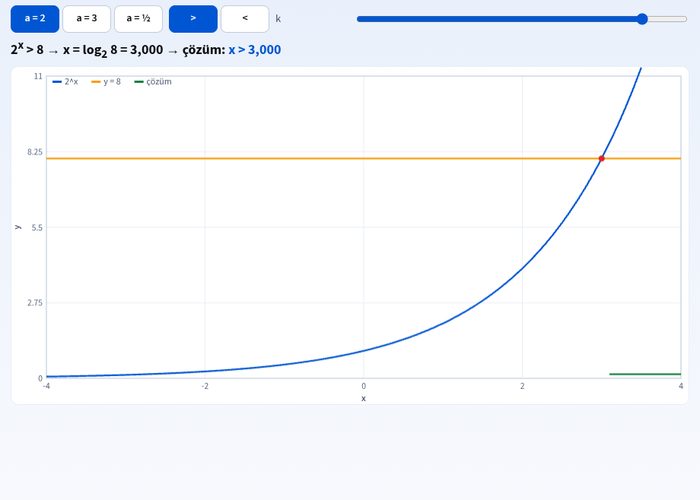
With the exponential and logarithmic equation and inequality problems simulation, you will learn to solve equations of the form aᵡ = k by the intersection of graphs or with the help of logarithms. This interactive tool allows you to find solution intervals for inequalities of aᵡ > k and examine real-life models such as population growth, drug half-life, and doubling time. You can practice by reinforcing the exponential functions and logarithms topics in mathematics class.
What can you do in this simulation?
You can solve exponential equations step by step and examine the intersection points on the graph.
You can observe the change of direction in inequalities by solving inequalities in two different base types.
You can reach the correct answers by solving exponential models and real-life problems.
You can do matching activities by dragging and dropping cards into the relevant boxes or by tapping.
You can save your predictions, test the results instantly via the experiment panel, and benefit from hints.
Basic concepts and formulas
Exponential equations are expressions of the form aᵡ = k and are solved as x = log_a(k) by taking the logarithm of both sides. The "70 rule", which applies to a quantity growing at a percentage r, is used to find the doubling time: t ≈ 70 / r (based on the relation ln 2 ≈ 0,693). When solving inequalities, attention is paid to whether the base is greater than 1 or between 0 and 1; the direction reversal rule is applied in the case of 0 < a < 1.
How to use?
Go to the experiment panel and examine the exponential and logarithmic questions that appear.
Make the necessary calculations, write your prediction, or move the cards to the relevant boxes.
Test your answer by pressing the "Check" button and see the correct results.
Proceed to advanced steps and solve inequality problems in different base types.
Reset the simulation using the Start Over button and try again with different scenarios.
Frequently asked questions
Why do we take logarithms when solving an exponential equation?
When the unknown quantity is in the exponent position, taking the logarithm of both sides allows you to bring the exponent forward as a coefficient and solve the equation linearly.
When does the direction change while solving an inequality?
When the base is a proper fraction between 0 and 1 (0 < a < 1), the inequality reverses direction when the bases are dropped in exponential inequalities.
What is the 70 rule and how is it applied?
The 70 rule allows you to quickly approximate the doubling time of a quantity growing or decaying at a constant percentage rate (r).
 Interactive experiment