Exponential function: change the base in the graph of f(x) = a^x; growth (a > 1) and decay (0 < a < 1); examine bacterial colony doubling, radioactive half-life and compound interest models using sliders
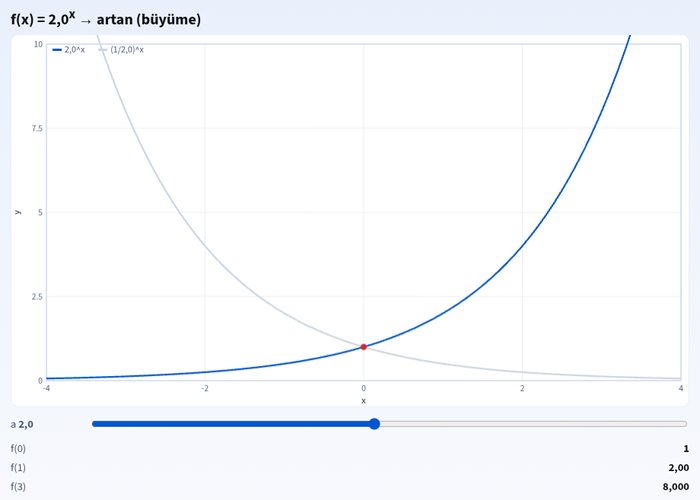
Explore exponential growth and decay concepts interactively with the exponential functions and their qualitative properties simulation. Thanks to this exponential function simulation, you will learn the behavior of the function by changing the base in the graph of f(x) = a^x, and examine real-world models such as bacterial colony doubling and radioactive half-life.
What can you do in this simulation?
You can observe graph changes by experimenting with 2 different growth bases and 2 different decay bases.
You can examine step by step the effect of the change in the base of the exponential function on the graph.
You can simulate the bacterial colony doubling model.
You can explore radioactive half-life processes and the logic of compound interest.
You can test your knowledge with guided questions and get instant feedback.
Basic concepts and formulas
Exponential functions are generally defined in the form f(x) = a^x. Here, the conditions a > 0 and a ≠ 1 must be met. If the base a > 1, the function exhibits exponential growth; the graph rises, increasing from left to right. If it is in the range 0 < a < 1, exponential decay occurs, and the graph rapidly approaches zero. Bacterial proliferation and radioactive decay are expressed with this mathematical model.
How to use?
Go to the experiment panel and start the exponential function simulation.
Observe the graph changes in the cases where a > 1 and 0 < a < 1 by changing the base value.
Examine the scenarios by selecting the bacterial colony and radioactive half-life models.
Test your predictions by answering the questions in the guide steps and check the results.
Frequently asked questions
What is the main difference between exponential growth and decay?
When the base a is greater than 1, the function values increase rapidly, resulting in exponential growth. When the base is between 0 and 1, the values decrease rapidly, forming an exponential decay model.
How does the bacterial colony model work?
The doubling of bacteria within a certain time interval (e.g., 20 minutes) is modeled mathematically with exponential equations such as f(x) = a^x or with a growth coefficient.
What topics does this simulation cover?
The simulation covers the quantities and change theme in the 11th-grade mathematics curriculum, specifically focusing on the qualitative properties of exponential functions and real-life applications.
 Interactive experiment