Logarithmic function: change the base and translations in the graph of f(x) = logₐ(x − h) + k; domain and vertical asymptote; numerically verify the rule that the logarithm of a product = the sum of logarithms; pH, decibel, and earthquake magnitude scales
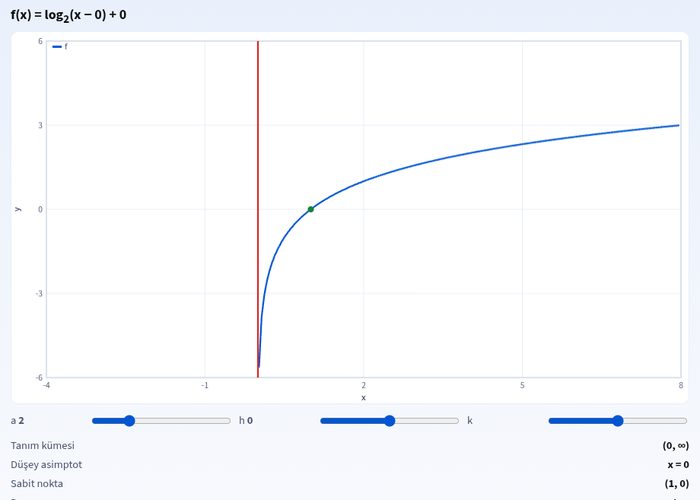
You can examine the graphs, base changes, and translations of the function f(x) = logₐ(x − h) + k interactively with the logarithmic function simulation. Thanks to this simulation, you will easily grasp the domain, vertical asymptotes, and qualitative properties of logarithmic functions.
What can you do in this simulation?
You can observe the changes in the logarithmic function graph by modifying the base and translation parameters.
You can numerically verify the rule of the logarithm of a product equals the sum of logarithms.
You can examine logarithmic scales such as pH, decibels, and earthquake magnitude using real-life examples like stomach acid, pure water, whispering, speaking, and a rock concert.
You can reinforce your theoretical knowledge by answering questions step by step with the guidance.
Basic concepts and formulas
Logarithmic functions are the inverse of exponential functions and are generally expressed in the form f(x) = logₐ(x) (where a > 0 and a ≠ 1). When the base a is greater than 1, the function is increasing, and when it is between 0 and 1, it is decreasing. The product rule is written as logₐ(x·y) = logₐ(x) + logₐ(y). Additionally, the decibel formula for sound intensity is used as L = 10·log(I/I₀).
How to use?
Go to the experiment panel and change the base and translation settings of the logarithmic function.
Examine the vertical asymptote and increasing/decreasing states on the graph of the function.
Test 3 different logarithmic scales such as pH, decibels, and earthquake magnitude.
Complete the matching tasks by dragging and dropping cards into the appropriate boxes or by tapping them.
Press the check button to verify your predictions and read the explanations in the guide.
Frequently asked questions
Can the base in a logarithmic function be 1 or negative?
No, by definition of the logarithm, the base must always be greater than 0 and must not be equal to 1.
What is a vertical asymptote?
It is the vertical line that determines the boundary of the domain of the logarithmic function and that the graph never intersects. For example, for f(x) = log(x - h), the line x = h is a vertical asymptote.
Why are logarithmic scales used?
They are used to convert very large or very small numerical values into more understandable and manageable ranges; earthquake magnitudes and sound decibels are examples of this.
 Interactive experiment