Inverse of an exponential function: construct the logarithmic function by reflecting points on the graph of y = a^x across the line y = x; swapping x and y on a table; a^y = x ⇔ y = logₐx transformation exercises
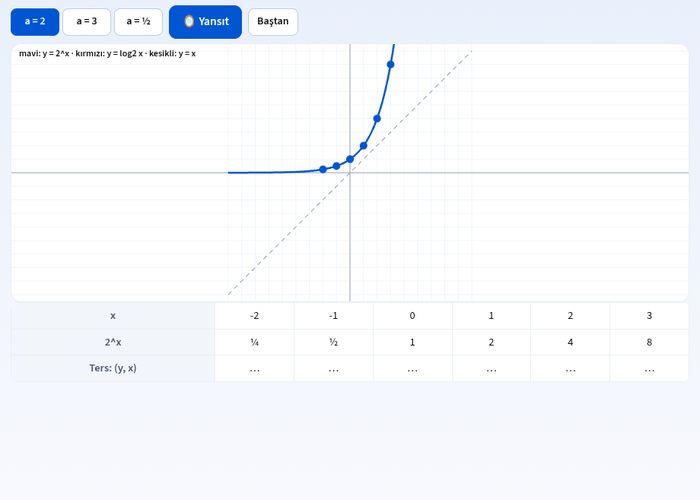
Explore interactively how exponential expressions transform into logarithmic format with the Inverses of Exponential Functions simulation. In this experiment, by reflecting the points on the graph of y = a^x across the line y = x, you will see how the logarithm function is formed and examine the swapping of x and y values on a table. This is a great opportunity to reinforce the relationship between exponential and logarithmic functions encountered in the Quantities and Changes theme of the 11th-grade mathematics course.
What can you do in this simulation?
You can create the logarithm graph with your own hands by reflecting the points on the exponential function graph across the line y = x.
You can grasp the logic of inverse functions by observing the swapping of x and y values on the table.
You can practice conversion exercises for a^y = x and y = log_a(x).
You can practice the steps for calculating various logarithmic expressions such as log_2(32), log_10(1000), log_3(1/9), and log_5(1).
By proceeding with the guidance, you can instantly check your correct and incorrect answers and track your score.
Basic concepts and formulas
The inverse of an exponential function is the logarithm function. To find the inverse of the function f(x) = a^x, x and y are swapped, yielding y = log_a(x). The basic conversion rule relies on the equivalence a^y = x and the expression y = log_a(x). Here, the condition a > 0 and a ≠ 1 applies.
How to use?
Open the experiment panel and follow the guide's instructions.
Draw the logarithm curve by reflecting the exponential function graph points across the line y = x.
Fill in the areas on the table where the x and y values are swapped.
Complete the requested exponential and logarithmic conversion exercises.
Verify your answers by clicking the check button and review your missing points.
Frequently asked questions
Why is the inverse of an exponential function a logarithm?
Finding the inverse of a function means swapping the inputs and outputs, that is, x and y. When we want to isolate x in the equation y = a^x, the definition of logarithm comes into play and y = log_a(x) is obtained.
What does reflection across the line y = x mean?
The graphs of a function and its inverse are symmetric with respect to the line y = x. This symmetry is the geometric counterpart of swapping the x and y axes.
What topics does this simulation cover?
The simulation covers exponential functions, the logarithmic function, the inverse function relationship, and the graphical representations of these expressions in the 11th-grade mathematics curriculum.
 Interactive experiment