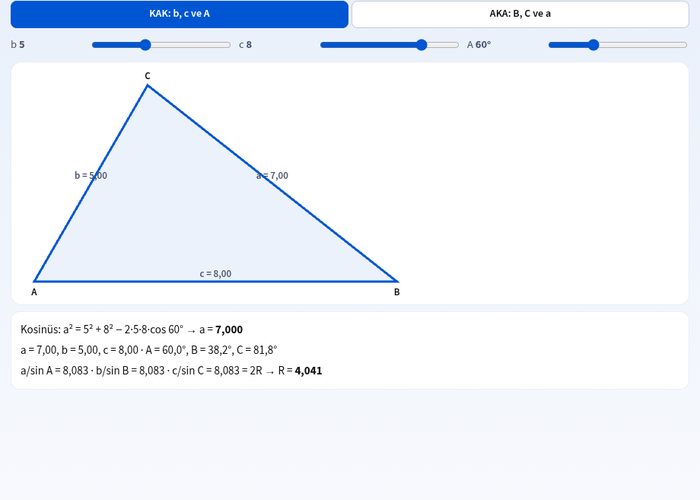
Sine and cosine theorems: find other elements from two sides and the included angle (SAS) or two angles and a side (ASA) in the triangle solver; a/sinA = 2R and a² = b² + c² − 2bc·cosA
With the Law of Sines and Law of Cosines simulation, you can interactively improve your triangle solving skills in geometric shapes. In this experiment, you will learn to calculate unknown sides and angles by examining SAS (side-angle-side) and ASA (angle-side-angle) cases.
What can you do in this simulation?
You can solve the given triangles step by step using the SSS and SAS methods.
You can place the cards into the correct boxes and columns by dragging and dropping or by tapping.
You can test your predictions with an experiment by getting hints from the guide panel.
You can instantly check your correct and incorrect answers and keep track of your score.
You can reset the experiment with the restart button and solve different triangle configurations again.
Basic concepts and formulas
The law of sines, which gives the ratio between sides and angles in any triangle, is in the form a / sin(A) = b / sin(B) = c / sin(C) = 2R. When three sides or two sides and the included angle are known, the law of cosines, which is the relation a² = b² + c² - 2bc·cos(A), is used.
How to use?
Open the experiment panel and examine the triangle problem presented to you.
Place the cards into the relevant boxes by tapping or dragging and dropping.
Test the correctness of your prediction by clicking the check answer button.
Review your calculations by utilizing the hints in the guide if necessary.
Move on to the next question with the next button and complete different triangle solutions.
Frequently asked questions
In which cases is the Law of Sines used?
The Law of Sines is used to find the remaining elements of a triangle when two angles and one side (ASA) are known, or when two sides and an angle opposite one of these sides are known.
What is the difference between the Law of Cosines and the Law of Sines?
While the Law of Sines relies on ratios, the Law of Cosines is a generalization of the Pythagorean theorem and is preferred especially for finding the third side when two sides and the included angle (SAS) are known.
How does this simulation help me with my school exams?
It allows you to understand triangle solving problems in geometry class through practice, enabling you to grasp the logic behind the formulas instead of memorizing them.
 Interactive experiment