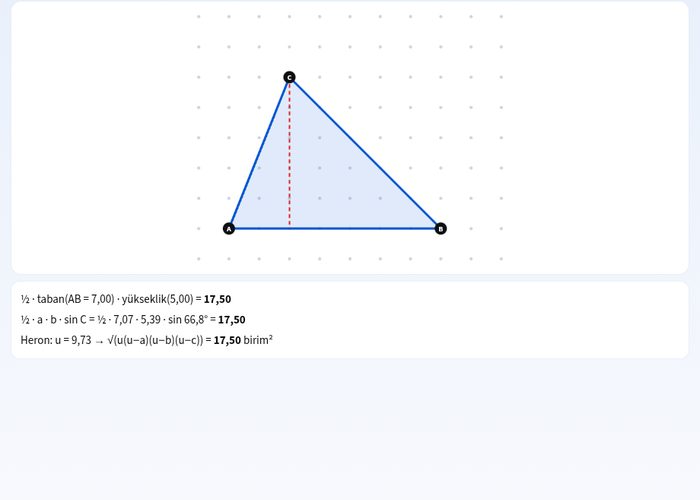
Area of a triangle: drag vertices on a grid; find the same area using base × height / 2, ½·a·b·sinC and Heron's formulas; triangles of equal area with the same base and height
The Area of a Triangle simulation allows you to interactively explore the area formulas you learned in geometry class. Thanks to this fun experiment, you can drag the triangle's vertices on the grid to test different area calculation methods at the same time and improve your math skills.
What can you do in this simulation?
You can drag the vertices of the triangle on the grid as you wish and change its shape.
You can instantly calculate the area using the classic base times height divided by two formula.
You can observe the trigonometric area formula relation 1/2·a·b·sinC.
You can verify the area based on the side lengths using Heron's formula.
You can examine how the areas of different triangles with the same base and height remain equal.
Basic concepts and formulas
In geometry problems, various formulas suited to different given data are used to find the area of a triangle. The most common method, the relationship between base and height, is expressed as Area = (base · height) / 2. When two sides and the included angle are known, the formula Area = (1/2) · a · b · sin(C) is used. For triangles with three known side lengths, Heron's formula Area = √(u·(u-a)·(u-b)·(u-c)) is applied with the semi-perimeter u.
How to use?
Open the experiment screen and drag the vertices of the triangle on the grid with your mouse.
Track the changes in side lengths and angles on the screen in real time.
Observe how the area results calculated by different methods agree with each other.
Follow the guide steps to answer the questions that appear and test your predictions.
Frequently asked questions
Why does the area remain unchanged when the vertex changes?
As long as you keep the base length and height constant, sliding the vertex along the parallel line does not affect the triangle's area.
In which cases is Heron's formula used?
It is used to find the area when you do not know the height of a triangle, but only have the lengths of all three sides.
When is the trigonometric area formula needed?
This formula is preferred to directly calculate the area when the lengths of two sides and the measure of the angle between them are known.
 Interactive experiment