Trigonometric ratios in right triangles: change the angle, view sin, cos, tan, cot values via opposite/adjacent/hypotenuse ratios; sin²x + cos²x = 1; unit circle and tower height measurement problem
Interactively explore geometry and trigonometry topics with the Trigonometric Ratios and Identities in Right Triangles simulation. Through this experiment, you can observe the ratios of opposite side, adjacent side, and hypotenuse lengths by changing the angle in a right triangle. You will learn how sine, cosine, tangent, and cotangent values change with the angle, their unit circle representations, and basic trigonometric identities alongside interactive questions.
What can you do in this simulation?
You can instantly examine side ratios on the right triangle by changing the angle.
You can track sin x, cos x, tan x, and cot x values using the opposite, adjacent, and hypotenuse side labels.
You can discover the geometric meaning of trigonometric values using the unit circle.
You can test your knowledge by answering the guided questions and receive instant feedback.
You can reset the simulation with the Restart button and repeat the experiment with different angles.
Basic concepts and formulas
Trigonometric ratios in a right triangle are defined as the ratio of the side opposite an acute angle to the hypotenuse, the adjacent side to the hypotenuse, and the perpendicular sides to each other. The fundamental trigonometric relations are as follows:
sin x = Opposite Side / Hypotenuse
cos x = Adjacent Side / Hypotenuse
tan x = Opposite Side / Adjacent Side
cot x = Adjacent Side / Opposite Side
sin²x + cos²x = 1 (Fundamental trigonometric identity)
How to use?
Open the experiment panel to examine the initial angle and triangle ratios.
Change the angle to observe the changes in the values of the opposite, adjacent, and hypotenuse sides.
Follow the on-screen updates of sine, cosine, tangent, and cotangent values.
Read the guide's instructions to answer questions and test your predictions.
Use the Reset button to make new attempts with different angles.
Frequently asked questions
Why can sine and cosine values in a right triangle not be greater than 1?
Because in a right triangle, the hypotenuse is always longer than either of the legs. Therefore, the ratio of the opposite or adjacent side to the hypotenuse can be at most 1.
How is the tangent value calculated?
The tangent of an angle is obtained by dividing the length of the opposite leg by the length of the adjacent leg for that angle. It is also equal to the ratio sin x / cos x.
Why is the unit circle important in trigonometry?
The unit circle with a radius of 1 unit allows us to geometrically see the signs, periodic behaviors, and projections on axes of trigonometric ratios from 0 to 90 degrees and beyond.
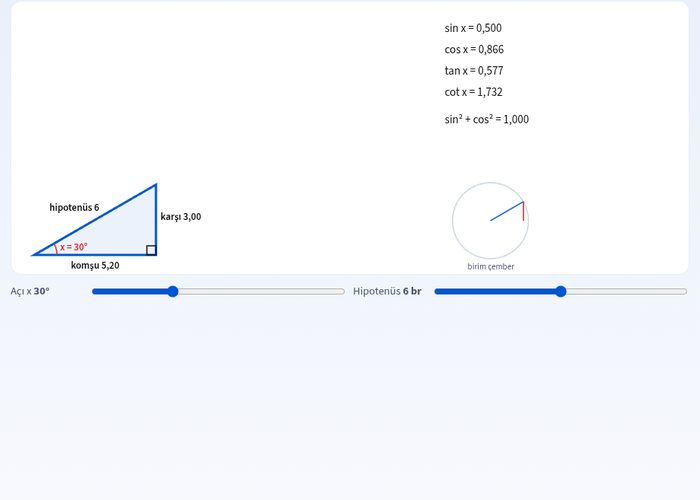 Interactive experiment