Auxiliary elements in triangles: medians (centroid), angle bisectors (incenter), altitudes (orthocenter) and perpendicular bisectors (circumcenter) in a triangle with draggable vertices
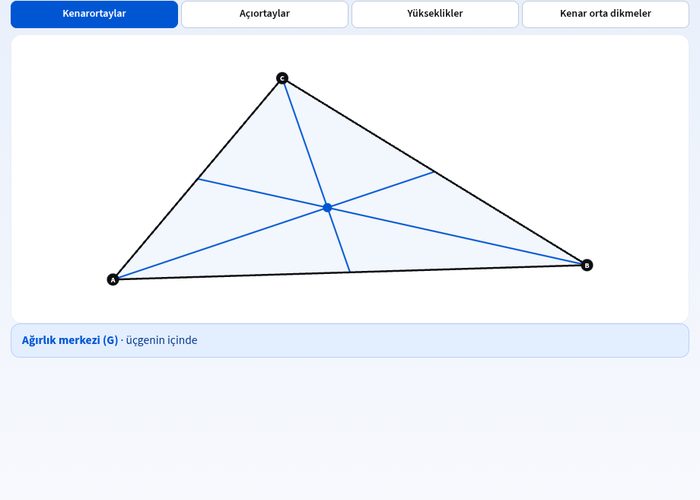
With the auxiliary elements in triangles simulation, you can interactively discover the fundamental auxiliary elements of a triangle and reinforce theorems in geometry class. This educational tool allows you to dynamically examine the concepts of median, angle bisector, altitude, and perpendicular bisector. You can change the shape of the triangle by dragging the vertices and observe the changes in the positions of special points.## What can you do in this simulation?- You can examine the medians and the centroid (G) of the triangle.- You can discover the incenter (I), which is the intersection point of the angle bisectors.- You can see the orthocenter (H) formed by the intersection of the altitudes.- You can find the circumcenter (O), which is the intersection point of the perpendicular bisectors.- You can test the behaviors of auxiliary elements in different triangle types by dragging the vertices of the triangle.## Basic concepts and formulasIn geometry class, the auxiliary elements of a triangle have unique properties. The centroid (G) is the intersection point of the medians and is divided in a ratio of 1 units to the side and 2 units to the vertex. The incenter (I) is the intersection of the angle bisectors and is equidistant from the sides of the triangle. The orthocenter (H) is the point where the altitudes intersect. The circumcenter (O) is the intersection point of the perpendicular bisectors and is equidistant from all three vertices.## How to use?1. Open the simulation screen and examine the auxiliary elements of triangles panel.2. Select one of the median, angle bisector, altitude, or perpendicular bisector modes.3. Change the shape of the triangle (as acute, obtuse, or right-angled) by dragging the vertices of the triangle with the mouse.4. Observe the positional changes of the resulting special points (G, I, H, O).## Frequently asked questions### Is the centroid always inside the triangle?Yes, the centroid (G) is always inside the triangular region regardless of the type of triangle (acute, right, or obtuse).### Can the orthocenter fall outside the triangle?Yes, in obtuse triangles, since the extensions of the altitudes intersect outside the triangle, the orthocenter (H) may be located in the exterior region of the triangle.### How is the circumcenter found?The circumcenter (O) is the intersection point of the perpendicular bisectors of the three sides and is equidistant from the vertices of the triangle.
 Interactive experiment