Mechanical energy: track the potential and kinetic energy of a child sliding down a water slide with real-time bars; conservation in the frictionless case, conversion to heat in the frictional case; speed and height calculations
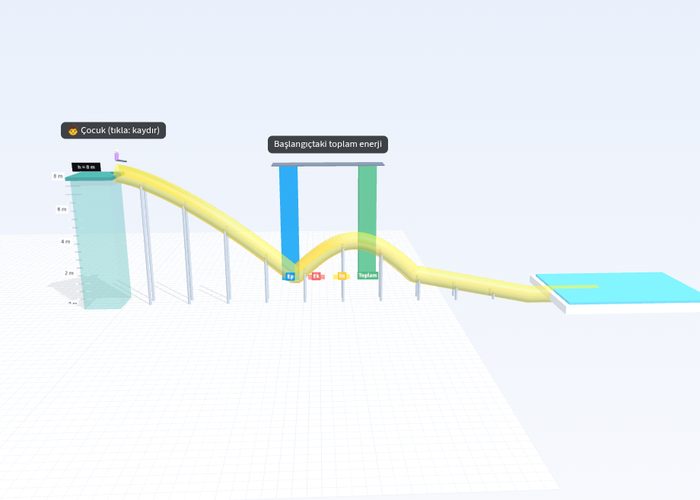
With the mechanical energy simulation, you can interactively examine the changes in potential and kinetic energy of a child sliding down a water slide. Thanks to this digital experiment, you can observe how energy is conserved in a frictionless environment and how mechanical energy is converted into heat in a frictional environment using real-time bar graphs. It is a great tool to reinforce the topic of energy transformations in physics class.
What can you do in this simulation?
You can track the instantaneous potential and kinetic energy of the child sliding down the water slide with bar graphs.
You can examine the motion and energy values of children with different masses by changing the mass.
You can test the conservation of energy with the frictionless slide option.
You can observe the conversion of mechanical energy into heat with the frictional slide mode.
You can navigate between steps and answer questions using the forward and backward controls.
Basic concepts and formulas
The mechanical energy possessed by objects is equal to the sum of kinetic energy and potential energy. In frictionless systems, mechanical energy remains constant: E_mechanical = E_kinetic + E_potential = Constant. Kinetic energy is calculated with the formula E_k = (1/2)·m·v², while gravitational potential energy is calculated with the formula E_p = m·g·h. When a friction force is present, part of the mechanical energy converts into heat.
How to use?
Go to the experiment panel and open the water slide simulation.
Determine the child's mass and the slide type (frictional or frictionless).
Slide the child and monitor instantaneous velocity and height changes with the on-screen bars.
Reinforce your knowledge by answering questions and checking your predictions.
Frequently asked questions
Is mechanical energy always conserved?
No, if there is friction or external resistive forces in the system, mechanical energy is not conserved; a portion of it turns into heat energy.
How are velocity and energy affected when mass changes?
In frictionless systems, mass does not change the velocity value, but it directly affects the magnitude of the total energy.
Where is the highest kinetic energy on a water slide?
It is at the lowest point where the child's potential energy is at its minimum, meaning the height is closest to zero and the velocity is at its maximum.
 Interactive experiment