Forms of energy and transformations: kinetic, potential, chemical, electrical, heat, light, sound, and nuclear energy; match input and output energy in everyday appliances, build an energy transformation chain
Explore the energy transitions in devices you encounter in daily life with the forms of energy and transformations simulation. You can learn how kinetic, potential, chemical, electrical, thermal, light, nuclear, and sound energy types transform into one another through interactive activities, and reinforce your knowledge by building energy conversion chains.
What can you do in this simulation?
You can examine different energy types such as thermal, light, nuclear, and electrical energy.
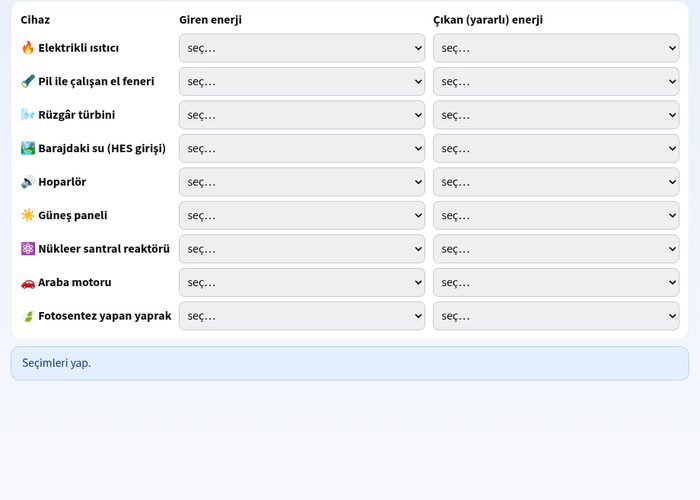
You can select the main input and output energy forms for devices such as an electric heater, water in a dam, a nuclear power plant reactor, and the sun.
You can create an energy conversion chain by dragging and dropping or tapping cards into the appropriate boxes.
You can save your predictions, find the correct answers by trying, and get instant feedback guided by the mentor.
You can reset the simulation using the Start Over button and solve all the steps again.
Basic concepts and formulas
According to the Law of Conservation of Energy, one of the fundamental laws of physics, energy cannot be created or destroyed; it only transforms from one form to another. The total mechanical energy or total energy in the system remains constant. The efficiency of devices can be calculated using the relation E_in = E_out + E_heat (loss). For example, in an electric heater, electrical energy is converted into heat energy.
How to use?
Start the experiment by reading the guide and instructions on the screen.
Examine the devices and energy cards to determine the incoming and outgoing energy forms.
Place a card by tapping it and then tapping its corresponding box, or by dragging and dropping it.
Test your answer by pressing the Check button and see the correct results.
Reset the experiment with the Start Over button and try different scenarios again.
Frequently asked questions
What are the forms of energy?
Energy exists in many different forms such as kinetic, potential, chemical, electrical, thermal, light, sound, and nuclear energy, and forms the basis of events in the universe.
What is energy transformation?
The conversion of one form of energy into another form of energy is called energy transformation; for example, solar cells convert light energy into electrical energy.
What does the law of conservation of energy mean?
This law states that the total energy in an isolated system always remains constant, and energy merely changes form.
 Interactive experiment