Work, energy, and power: calculate the area under the force-displacement graph, examine the work done by an angled force; lift the same load with two motors in different times and compare power
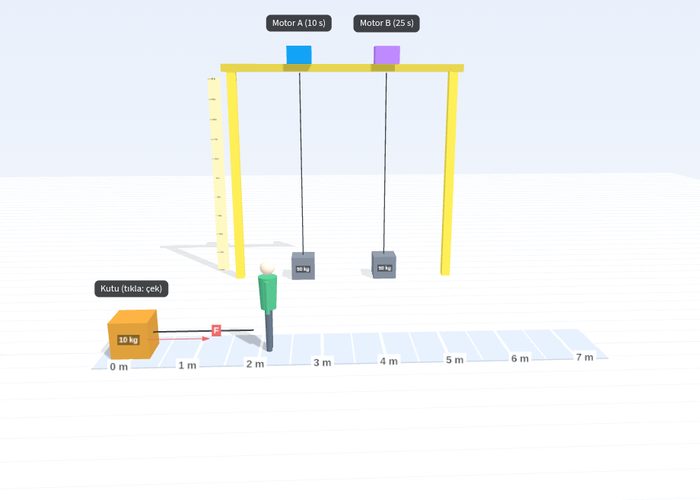
Explore fundamental concepts in physics interactively with the work, energy, and power simulation. Thanks to this work, energy, and power experiment, you will grasp the physical meaning of force-displacement graphs, directly observe the work done by angled forces, and see the power differences between motors.
What can you do in this simulation?
You can perform work calculations using constant 20 N force, linearly increasing spring force, and stepped profile options.
By pulling the box for 6 m, you can easily calculate the area under three different graphs.
You can examine the effect of an angled force on the work done by trying angles of 0 degrees, 60 degrees, and 90 degrees.
By following the guide step by step, you can compare your predictions with experimental results and reinforce your knowledge.
Basic concepts and formulas
Work done in physics is the product of the applied force and the displacement in the direction of this force, and it is expressed by the formula W = F · x · cos(θ). The area under the force-displacement graph gives the total work transferred to the system. Power is the work done per unit time and is calculated by the formula P = W / t; with this simulation, you can clearly see the effect of work done in different time intervals on power.
How to use?
Go to the experiment panel and review the steps and questions presented with the guidance of the guide.
Move the box 6 m by choosing one of the fixed, spring, or stepped profile options.
Observe the graph areas and calculations by trying different force angles (0°, 60°, 90°).
Verify your predictions by pressing the check predictions button and complete your missing parts.
Frequently asked questions
What does the area under the force-displacement graph give?
The area under this graph represents the total work done on the object and provides information about the change in energy.
What is the effect of the angle on the work done?
As the angle between the force and displacement increases, the cos(θ) value in the work formula decreases and the net work done diminishes; at 90 degrees, the work becomes zero.
What is the relationship between power and work?
While work indicates the total energy transfer, power determines how fast this transfer occurs and is inversely proportional to time.
 Interactive experiment