Geometric representation of identities: area models for (a + b)², (a − b)², and a² − b²; truth tables for propositions, negation, and/or, conditional (implies), and biconditional connectives; universal/existential quantifiers
Interactively explore the geometric foundations of identities and the truth values of logic propositions with the algebraic expression of real number operations simulation. This activity allows you to connect algebraic expressions with visual models and develop your mathematical reasoning skills.
What can you do in this simulation?
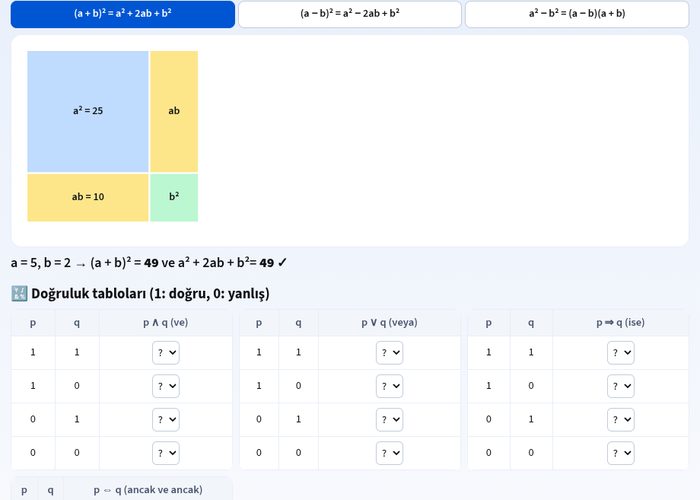
You can examine the geometric equivalents of identities in the area model and visualize the expressions (a + b)², (a − b)², and a² − b².
You can test each of the three identities with different (a, b) number pairs.
You can fill out truth tables for the logical connectives and, or, conditional, and biconditional.
You can examine propositions containing universal (∀) and existential (∃) quantifiers and the negations of these propositions.
Basic concepts and formulas
In mathematics, identities are equalities that hold true for all real values that variables can take. Area models represent these equations as geometric areas. For example, the difference of squares formula is expressed as a² − b² = (a − b)·(a + b). In logic, compound states of propositions p and q are shown with truth tables; for example, the conditional proposition is expressed as p ⇒ q.
How to use?
Select the identity or logic topic you want to examine from the experiment panel.
Make the correct matches by dragging and dropping cards in the area model or by tapping the boxes.
Check the results of the connectives by filling in the cells in the truth table.
Review the results after saving your guesses and repeat the steps if necessary.
Frequently asked questions
What is the purpose of the geometric representation of identities?
Area models help you understand that algebraic expressions are not just piles of letters, but actually the sum or difference of geometric areas by making them concrete.
What should I pay attention to when filling out a truth table?
You can fill in the 16 cell step by step by remembering the basic rules of the connectives and (∧), or (∨), conditional (⇒), and biconditional (⇔).
How do you negate quantifiers?
While the universal quantifier (∀) becomes existential (∃) upon negation, the proposition itself is also made negative. The same rule applies in the reverse direction.
 Interactive experiment