Exponential and radical representations: a ball bouncing to half its height on each impact, exponent rules machine (multiplication, division, power of a power, negative and fractional exponents), scientific notation from the atom to the universe
Interactively explore powers of numbers, root degrees, and universal magnitudes with the exponents and radicals of real numbers simulation. In this math experiment, you will test exponent rules, scientific notation, and numerical magnitude relationships with interactive tools. You can strengthen your basic algebra skills by seeing how exponents are added or subtracted when the bases are the same.
What can you do in this simulation?
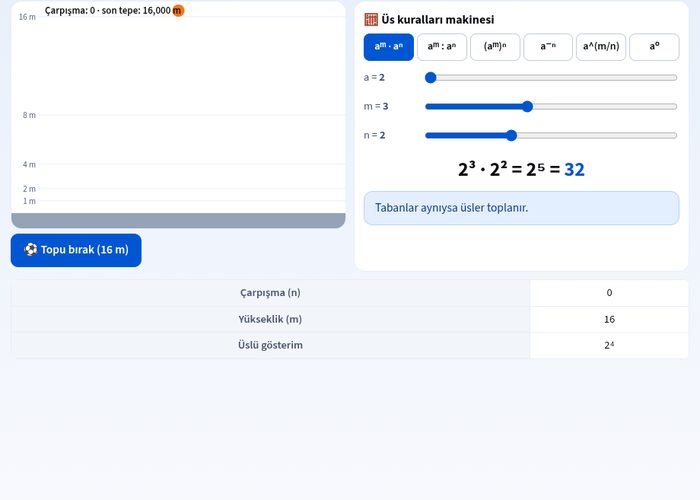
You can learn by experimenting with six basic exponent rules: multiplication, division, power of a power, negative, and fractional exponents.
You can examine the logic of exponential decay with the bouncing ball simulation, whose height changes with every bounce on the ground.
You can tour the range of scientific notation from atomic diameter to the observable universe by using the scale slider.
You can reinforce what you have learned and get instant feedback by dragging and dropping cards into the correct boxes.
You can test your theoretical knowledge with practice by answering questions under Raista's guidance.
Basic concepts and formulas
In exponential expressions, the multiplication of two numbers with the same base is found by keeping the base the same and adding the exponents: a^m · a^n = a^(m+n). In division, the exponents are subtracted: a^m / a^n = a^(m-n). A negative exponent allows taking the reciprocal of the number: a^(-n) = 1 / a^n. Scientific notation, used to express very large or very small numbers, is written as a · 10^n, where the condition 1 is less than or equal to a, which is less than 10, is sought.
How to use?
Open the experiment panel and follow the instructions in the guide.
Try different base and exponent values using the exponent rules machine.
Examine the magnitudes ranging from the atom to the universe by moving the scale slider.
Place the cards into the correct boxes in card matching activities.
Repeat the experiment by making use of hints in steps you cannot solve or find difficult.
Frequently asked questions
What does a negative exponent mean?
A negative exponent does not make the value of the expression negative; it simply indicates that the reciprocal of the base should be taken. For example, 2 to the power of minus two means 1 / 2^2, which is 1/4.
Why is scientific notation used?
Scientific notation is preferred to write and compare very large or very small numbers practically without a crowd of zeros.
What happens to exponents when dividing with the same bases?
When the bases are the same and non-zero, the exponent of the denominator is subtracted from the exponent of the numerator when dividing exponential expressions.
 Interactive experiment