Real number intervals: set endpoints and open/closed states on the number line; interval, set, and absolute value notations; union, intersection, and difference of two intervals
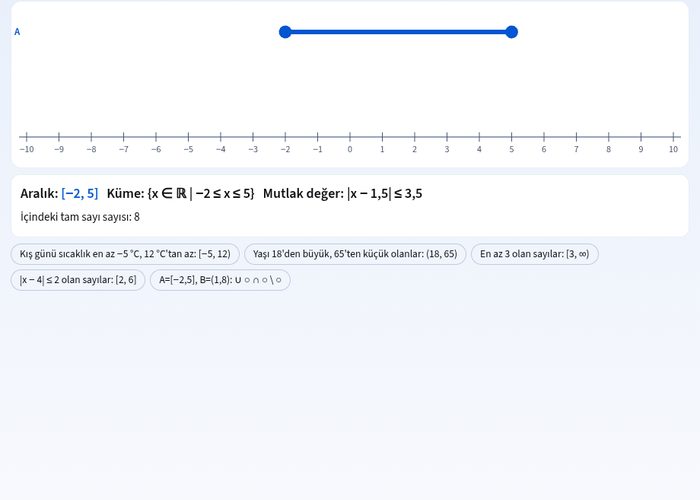
Explore intervals on the number line, open/closed endpoints, and set notations interactively with the real number intervals and set symbols simulation. You can use the sliders on the panel to adjust the endpoints of intervals A and B, and use the checkboxes to specify whether the endpoints are included. Thanks to this simulation, you can easily learn set operations such as union, intersection, and difference of two intervals by visualizing them on the number line.
What can you do in this simulation?
You can change the start and end points of intervals A and B using the sliders on the panel.
You can use the checkboxes to determine whether the endpoints are included (open or closed interval).
You can examine the transitions between interval, set, and absolute value notations.
You can check your work by setting up target intervals and achieve correct results.
Basic concepts and formulas
Real number intervals cover all numbers between two points on the number line. For example, if a is included and b is not included, the half-open interval is denoted as [a, b) and its set notation is {x | a <= x < b}. The union of two intervals is expressed with the symbol A ∪ B, and their intersection with A ∩ B.
How to use?
Open the experiment panel and adjust the endpoints of interval A using the sliders.
Select whether the endpoints will be included using the checkboxes.
Apply the same steps for interval B to create the second interval.
Complete the target intervals by observing union, intersection, and difference operations on the number line.
Frequently asked questions
What is the difference between an open interval and a closed interval?
In a closed interval, the endpoints are included in the interval and square brackets [ ] are used. In an open interval, the endpoints are not included and parentheses ( ) are used.
How do union and intersection operations look on the number line?
While the union covers all elements of both intervals, the intersection shows only the region common to both intervals.
How is absolute value related to intervals?
For example, the inequality |x - a| < b corresponds to the open interval (a - b, a + b) and represents an interval centered at a on the number line.
 Interactive experiment