Right pyramid and right cone: examine square, triangular, and hexagonal based pyramids and cones in 3D; view elements like apex, height, slant height with labels; draw their nets on the panel, compare face–edge–vertex counts
Explore geometric solids in three dimensions with the right pyramid and right cone simulation, and easily learn the relationships between faces, edges, and vertices.
What can you do in this simulation?
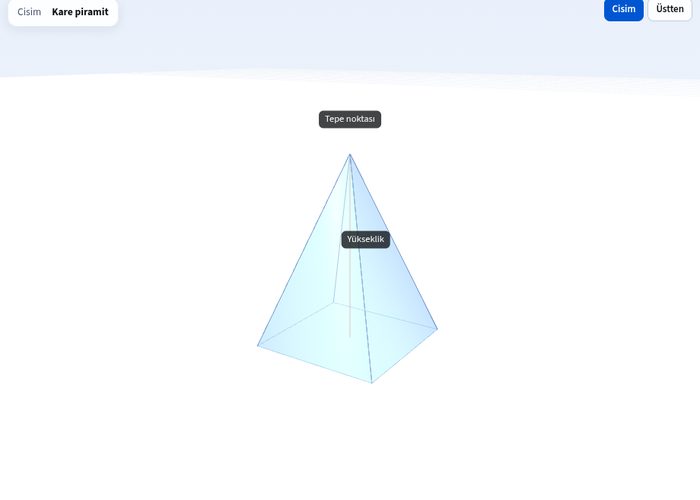
You can examine 4 different solids: triangular pyramid, square pyramid, hexagonal pyramid, and right cone.
You can view basic elements such as the apex, height, and slant height with labels.
You can draw the nets of the solids on the panel and observe the base circle or lateral surface nets.
You can examine the projections of the solids using the top view.
Basic concepts and formulas
Right pyramids consist of a polygonal base and triangular lateral faces that meet at a common apex. A right cone, on the other hand, is a rotational geometric solid formed with a circular base and a slant height. In pyramids, the lateral area is equal to half of the product of the base perimeter and the slant height: Area = (Base Perimeter · Slant Height) / 2. In the net of a cone, the lateral surface is a sector of a circle whose area is found using the formula π·r·l (where r is the base radius and l is the slant height).
How to use?
Select the solid you want to examine (triangular pyramid, square pyramid, hexagonal pyramid, or right cone).
Track elements such as the apex, height, and slant height via the solid panel.
Open the net mode to observe how the solid unfolds onto a plane.
Reinforce what you have learned by answering questions and following the guide.
Frequently asked questions
What shapes make up the net of a right cone?
The net of a right cone consists of a circle (base) and a circular sector (lateral surface).
How do you find the numbers of faces, edges, and vertices of pyramids?
Given that the number of base sides is n, it is calculated with the formulas: n+1 faces, 2n edges, and n+1 vertices for a square pyramid.
What is the slant height?
It is the length of the line segment connecting the apex of a right cone to a point on the base circle.
 Interactive experiment