Translation and reflection: translate a shape left–right, up–down on a grid plane; reflect it across the x-axis and y-axis; apply successive transformations and observe how vertex coordinates change in the table
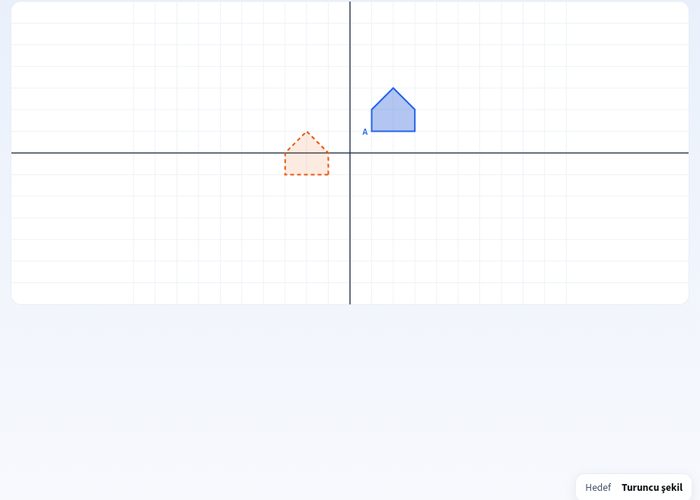
Are you ready to explore how shapes displace and take a mirror image in the world of geometry? With the translation and reflection simulation, you can slide shapes right, left, up, or down on a grid; and instantly observe coordinate changes by reflecting them across the x and y axes. By applying sequential transformations, you can track the final position and vertex coordinates of the shape in the table, and learn how the order of transformations affects the result.## What can you do in this simulation?- You can translate a shape right, left, up, or down on a grid.- You can obtain a mirror image by reflecting shapes across the x-axis and y-axis.- You can try to reach the goal by applying sequential transformation steps.- You can test how the order of transformations changes the coordinates and the result.- You can reinforce your knowledge by answering questions with the guidance of the guide.## Basic concepts and formulasTranslation in the coordinate plane is shifting a point (x, y) by a certain amount along the axes. For example, a translation of a units to the right and b units up is expressed as (x + a, y + b). Reflection, on the other hand, is taking the symmetric of a shape with respect to an axis; in reflection across the x-axis, y changes sign (x, -y), and in reflection across the y-axis, x changes sign (-x, y). In sequential transformations, the order (composition) of operations is of great importance.## How to use?1. Open the experiment panel and examine the initial shape and the goal on the grid.2. Apply the first transformation to the shape using the translation and reflection buttons.3. If necessary, add the second step (sequential transformation) to bring the shape closer to the target position.4. Track how the vertex coordinates change from the table and click the check button.5. Try different scenarios again using the Reset button.## Frequently asked questions### Does the size of the shape change when translating?No, translation only changes the position of the shape; its size, angles, and side lengths remain completely the same.### Does the order of reflection and translation affect the result?Yes, the order is quite important in transformation geometry. Reflecting first and then translating can yield different results than translating first and then reflecting.### How are coordinate changes found?In reflection across the x-axis, the sign of the y-coordinate reverses, while in reflection across the y-axis, the x-coordinate changes sign; in translation, the added or subtracted units are directly reflected in the coordinates.
 Interactive experiment