Right prisms: rotate a right prism with a triangular, square, pentagonal, or hexagonal base in 3D; count the numbers of faces, edges, and vertices; examine its net; calculate surface area and volume by changing side lengths
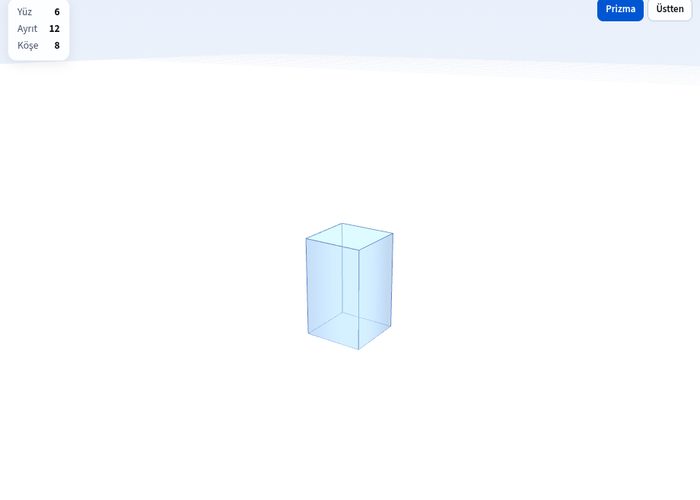
With the right prisms simulation, you can examine three-dimensional geometric objects with triangular, square, pentagonal, and hexagonal bases, and discover the number of faces, edges, and vertices. This interactive experiment helps you reinforce the topic of right prisms in the 8th grade math curriculum and learn formulas by concretizing them. You can perform surface area and volume calculations by changing edge lengths and easily examine the nets of the objects.
What can you do in this simulation?
You can examine 4 prisms with different bases in three-dimensional space.
You can observe changes in volume and surface area by changing edge lengths.
You can discover the patterns n + 2, 3n, and 2n by counting the number of faces, edges, and vertices.
You can see their two-dimensional versions by examining the net of the prism.
You can test your knowledge by answering questions accompanied by a guide.
Basic concepts and formulas
Right prisms are geometric objects whose bases are parallel congruent polygons and whose lateral faces are rectangles. If the number of base edges is called n; the number of vertices is not n + 2 but 2n depending on the base type, the number of edges is 3n, and the number of faces is n + 2 (for example, for a square prism where n=4, there are 6 faces, 12 edges, and 8 vertices). The volume of a right prism is calculated with the formula V = Base Area · Height (V = B · h). The surface area is the sum of the areas of all faces: Surface Area = 2 · Base Area + Lateral Area.
How to use?
Open the simulation in your browser and select one of 4 different prism models.
Update the dimensions of the object by changing the edge length and height settings.
Follow the changes in volume and surface area values on the screen.
Examine the unfolded version of the prism using the net mode and answer the questions in the guide.
Frequently asked questions
How do you find the volume of a right prism?
The volume of a right prism is found by multiplying the base area by the height. Its formula is V = Base Area · Height.
How many faces, edges, and vertices does a square prism have?
Since the base of a square prism is a square, n=4. Accordingly, it has 6 faces, 12 edges, and 8 vertices.
What is the net of a prism used for?
A net is the two-dimensional unfolded representation of the surfaces of a three-dimensional object. This allows you to clearly see the shapes that make up its surface area.
 Interactive experiment